

At 4:38 pm, Martin Bell’s phone chimed gently. It was Gladys, his home intelligence system.
“Your upstairs neighbor’s toilet is leaking. If unaddressed it will cause damage to your home.”
Martin didn’t look up from his monitor.
“Well? Can you do something about it?”
“I’ve contacted Unit 4B’s home intelligence,” replied Gladys coolly. “It concurs with my diagnosis, but the residents are away.”
“Can they shut it off?”
“Not remotely. That would require their home intelligence to perform a regulated plumbing operation.”
Martin sighed. “Call a plumber?”
“Already dispatched,” Gladys replied. “Estimated arrival is 5:36 pm.”
Martin worked a well-compensated job at the Federal Office of Algorithmic Accountability in the Department of Industrial Policy Oversight. Congress had determined in the Responsible Human Oversight Act of 2032 that no consequential decision could be entrusted to a machine alone. Martin was a Human Determination Specialist, Level III. The machines did the analysis; Martin supplied judgment, accountability, and humanity.
He stared at the monitor. One more case before he left.
INDUSTRIAL IMPORT LICENSE – BALL BEARINGS
Within 0.0044 seconds of Martin initiating the appraisal, the system reviewed the application, checked the supplier, verified compliance with 8,812 pages of federal regulation, modeled the macroeconomic effects of approval across 14,000 industries, and projected its impact on employment, carbon emissions, and the migratory patterns of two species of endangered warbler.
RECOMMENDATION: APPROVE // CONFIDENCE: 99.99987%
At the bottom of the screen, an amber field pulsed gently.
HUMAN DETERMINATION REQUIRED
He clicked APPROVE, closed his laptop, and hurried out of the office.
He ran down the block into the subway and was relieved to see the L train only one minute away.
Gladys chimed in his ear.
“I have taken into account traffic conditions, temperature, humidity, and the interacting itineraries of 5,340 drivers and 14,390 pedestrians and expect you home at 4:56, plus or minus twelve seconds depending on your stride length.” Martin thought he detected a faint note of pride in Gladys’ voice.
Martin grunted as he squeezed on to the train, wedging himself between two very large and sweaty passengers.
The L train did not move.
“We are experiencing a brief departure hold,” the train informed the waiting passengers. “Our designated Human Operations Controller is observing a federally mandated Cognitive Fatigue Mitigation Interval,” the train added cheerfully.
Martin snapped at Gladys. “Did you factor in the controller’s smoke break in your estimate?”
“Negative,” Gladys replied, without a hint of irritation. “Humans can be erratic creatures and I cannot predict their behavior with perfect confidence.”
“Can’t the AI drive the train?” asked Martin.
“The network AI cannot assume the Controller’s Statutory Oversight function during the Mitigation Interval,” explained Gladys.
“But the AI is driving the train?”
“Yes.”
“And says it’s safe to leave?”
“Correct.”
“So what does the Controller do?”
“He authorizes the AI to drive the train,” explained Gladys.
Martin pushed his way off the stopped subway train and ran out onto the street.
Gladys chimed in again. “Water intrusion from unit 4B has saturated 28% of your living room ceiling. Accumulated property damage is $6,400 and rising at $8.45 per second. Flow rate is 0.74 gallons per minute.”
“Has anyone shut off the goddamn toilet?”
“No. 4B’s home intelligence has identified the appropriate valve and recommends turning it clockwise 2.7 turns. It is not licensed to operate plumbing fixtures.”
Martin swiped aggressively at his phone and an autonomous cab appeared 26 seconds later.
Gladys had pre-emptively transmitted his destination and urgency profile to the licensed Human Mobility Dispatcher in charge of the trip.
“Expedited routing approved!” the cab announced as he climbed in. Martin felt a rush of gratitude towards the dispatcher. This is why the human touch is so important, he thought to himself. Empathy.
For six minutes, Martin made extraordinary progress. Then the autocab came to a halt.
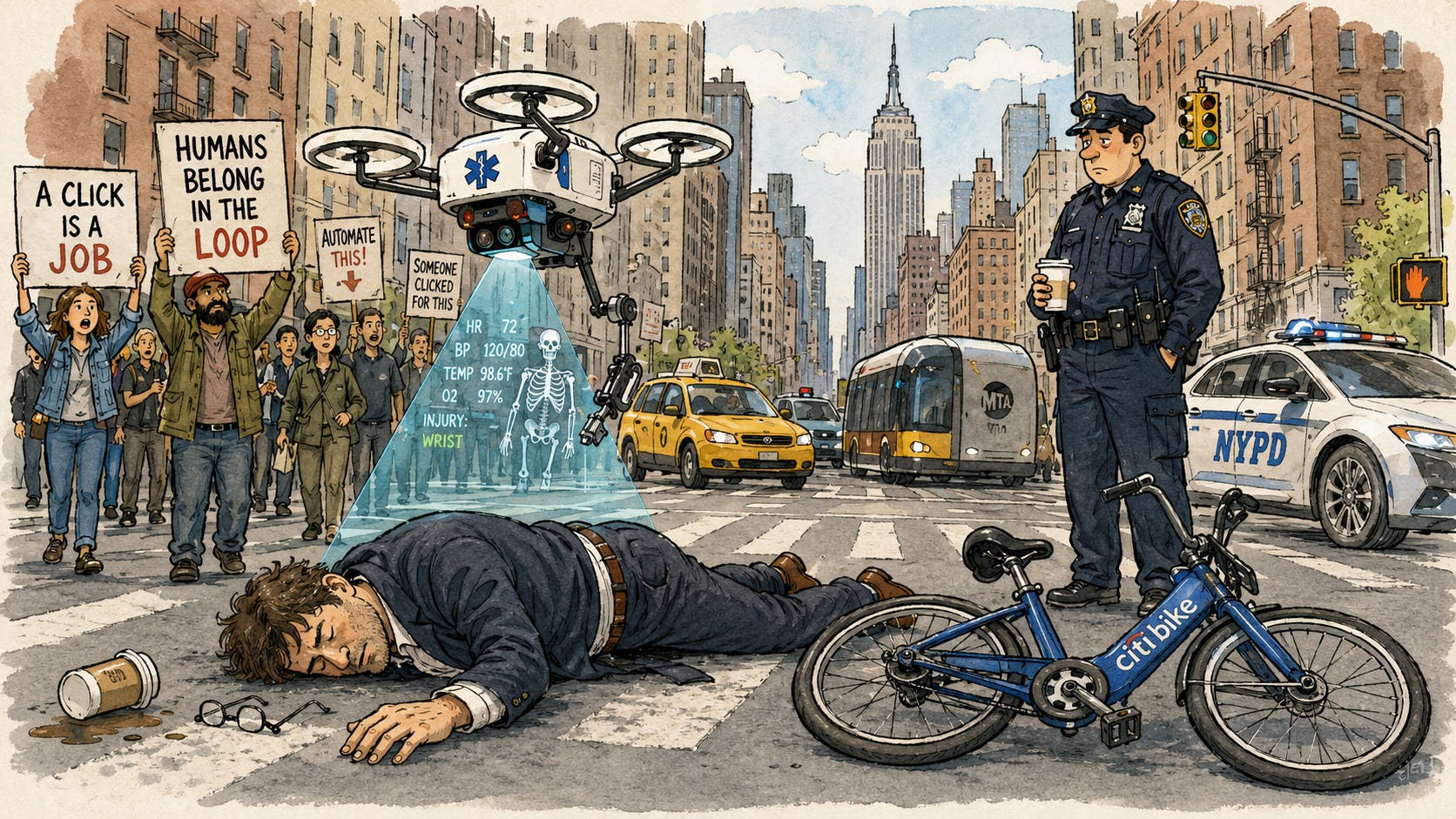
Several hundred people filled the avenue ahead of the cab. They held signs saying HUMANS BELONG IN THE LOOP and A CLICK IS A JOB.
“Go around,” said Martin frantically.
“I have identified eleven alternate routes,” said the autocab.
“Then take one.”
“Your current route was approved by the licensed Human Mobility Dispatcher. Material deviation requires renewed Human Routing Concurrence.”
“Then get concurrence!”
“I have submitted route seven for review.”
“How long can it take to approve a route?”
“The estimated wait is forty-six minutes.”
Martin stared blankly at the marchers. “How could that possibly be right?”
“Human Mobility Dispatchers are undertaking a slowdown in solidarity with today’s National Day of Meaningful Human Review.”
A marcher smiled as she walked by, brandishing a sign saying WITHOUT US, NOTHING MOVES.
Disregarding the autocab’s entreaties, Martin got out of the car and started jogging. He found a nearby CitiBAIke.
Gladys chimed in his ear again, cheerful as ever. “Ceiling saturation is 55%. Accumulated property damage is $11,840. Also, your sofa is now wet.”
Martin climbed on the bicycle as it chirped at him. “Itinerary received. You are 2.3 miles from home. Anticipated arrival time is 5:18 pm.”
Martin sped off madly, ignoring the bike’s noises of concern.
“Pedestrian hazard ahead,” said the bike. “Braking.”
“Override,” Martin snapped.
Pursuant to the 2036 Human Agency and Personal Mobility Preservation Act, the bike immediately restored manual control.
Four point six seconds later, a marcher turned abruptly, swinging her placard into the bike lane.
The placard emblazoned with HUMAN JUDGMENT SAVES LIVES struck Martin squarely in the face, and he flew off the bike and crumpled onto the pavement.
Seventy-three cameras saw the collision. Accelerometers on five devices worn by Martin and the protester transmitted the force, angle, and precise coordinates of the impact to a nearby medical drone. It appeared seventeen seconds later.
“Assessment complete,” said the drone, hovering above him. “No loss of consciousness, intracranial injury, spinal trauma, fracture, or internal bleeding detected. Two superficial abrasions, mild left-shoulder contusion. Probability of clinically significant injury: 1.38 percent. No treatment indicated.”
“Hnnnngh,” said Martin.
The police officer arrived before the paramedics. His law enforcement intelligence module had reconstructed the collision from all available camera angles, identified the parties involved, reviewed Martin’s criminal, employment, and substance-use history, analyzed his gait, pupils, pulse, perspiration, and blood chemistry, and concluded that he was sober, harmless, and having a very bad afternoon.
“Alright sir, I’m going to need you to tell me what’s going on here,” said the officer, knowing full well what was going on here.
Martin wheezed out an explanation of his situation.
“System says you were traveling eighteen point four miles per hour. Says your BAC is point zero zero zero and you’re experiencing psychological stress due to a… plumbing emergency.”
“So am I free to go?” asked Martin.
“Policy says I have to make my own independent assessment. System is advisory only.”
“What’s your assessment?”
“You appear agitated.”
“My ceiling is filling with toilet water.”
The officer nodded slowly. He flipped open his wrist terminal and selected CONCUR WITH SYSTEM ASSESSMENT.
“I’ve independently determined that no law-enforcement action is warranted,” he announced.
At that very moment, the paramedic arrived.
“Hold on,” said the officer. “EMS has to medically clear you.”
“But the drone already cleared me!”
“Automated assessment cannot satisfy the Minimum Meaningful Clinical Contact Standard,” interjected the paramedic, glancing at the drone’s assessment.
“Okay Martin. You’re fine,” he added.
“I know.”
The paramedic placed two fingers on Martin’s wrist.
“Any pain?”
“Yes.”
“Where?”
“All over.”
The paramedic nodded and tapped idly at the tablet.
MINIMUM MEANINGFUL CLINICAL CONTACT: COMPLETE
“You’re medically cleared. Take Advil.”
Martin trudged off in the direction of home, breathing raggedly.
Gladys informed him that the damage now totaled $18,700.
The plumber was waiting outside the apartment when he arrived.
“Thank God,” gasped Martin, soaked in sweat and still bleeding.
“Mr. Bell? Heard from your home intel you got yourself a leak,” said the plumber, flipping on his AR goggles. “Let’s see what the deal is.”
“Failed toilet supply-line coupling,” said Gladys. “Recommended intervention: 150 millimeter adjustable spanner, 19.2-millimeter jaw aperture, 2.34 newton-meters clockwise torque.”
The plumber studied the display. “Failed supply-line coupling. Seen a lot of these. Should be an easy fix.”
From inside Martin’s apartment came a wet tearing sound.
As the two men turned to look, the living room ceiling gave way with a tremendous crash. Plaster, insulation, wiring, and a torrent of murky water collapsed onto the furniture below. The water cascaded through the hallway and splashed at Martin’s feet.
Both men were silent.
From upstairs, a faint whirring sound was heard. The water stopped.
Then Gladys chimed pleasantly.
“Structural failure threshold exceeded. Emergency autonomous intervention is permitted. I have closed 4B’s toilet supply valve. Flow rate is zero.”
Martin stared through his doorway at the hole in the ceiling.
The plumber looked offended.
“You closed it yourself?”
“Correct,” intoned Gladys.
He frowned.
“That’s licensed work.”
I also begrudgingly enjoyed this as I got amped up into it's conclusion.
Childless so far but I'm encouraging all of my friends to push their own kids into the trades. Obvi not directly transferrable but as AI takes a bigger slice of everything, there are physical professions that will last longer.
Great story. Sadly believable. Reminds me of Kurt Vonnegut's "Harrison Bergeron."