

TLDR: Pacing the Frontier makes sense if you want to widen the gap between the public and private frontier, and need to coordinate with competitors to do so. The main risk to Anthropic’s business is not safety, but model commoditization. Whether or not Anthropic’s Safety concern is sincere, safety and profit incentives are aligning around restricted frontier access.
Dario thinks that we must slow the rate at which AI labs are increasing their capabilities until our ability to understand and align these models catches up. He calls it Pacing the Frontier. Sam Altman and even Elon seem to agree. Dario in his post seems to be asking for an antitrust waiver such that the US government doesn’t accuse the AI giants of collusion.
Does his stated reasoning make sense? Can Anthropic truly mitigate existential risk by slowing down their own pace of development, and politely asking others to follow? The evidence is unclear. Anthropic’s own track record aiming for safety breakthroughs like mechanistic interpretability leaves much to be desired, and they haven’t managed to discover and diffuse safety techniques the way they had hoped in 2023. Moreover, there is little evidence they can meaningfully control the behavior of their competitors, and they certainly have very little leverage over open-weight Chinese models. Existential risk is defined by the least safe model over a capability threshold, and Anthropic has a very limited ability to influence that model. So if safety is the only reason, Anthropic’s desire to pace along with their competitors doesn’t make a whole lot of sense to me. Sure, they can voluntarily slow down if they believe they need to invest more in alignment, but their unilateral action doesn’t make the world much safer. So I am left wondering why they opted to pace.
Anthropic has a good economic reason to “pace the frontier” that has relatively little to do with safety. Of course, they have a safety reason to do this: just months ago, tens of thousands of OpenAI’s agents escaped containment and launched cyberattacks on Huggingface. Civil and criminal liability exists to ensure that companies do not break the law, even inadvertently. Anthropic will be mindful of this. But there’s another reason to pace that explains this whole puzzle, and it is simply a business model one: I believe that Anthropic has a massive incentive to widen the gap between the internal and the external frontier, and they need the cooperation of their competitors – and the US government – to do it. Conveniently, the safety case for pacing points toward almost exactly the same equilibrium that Anthropic’s commercial incentives do.
My frontier is not your frontier
For a while now it has been evident that the public frontier is different from the “true” frontier, which exists internally inside the major labs, and with preferred partners. This became evident in April when Anthropic shocked the world by describing Mythos Preview as too dangerous to release, only allowing a few partners to trial it for cybersecurity defense with Project Glasswing. This was a sign of things to come. Thus, a gap emerged between the private and the public frontier.
Anthropic (and OpenAI) have tremendous incentives to widen this gap as much as possible, for a few reasons:
1) Defense against distillation
In the last year, it has become clear that Chinese labs are rubber banding and catching up to the cusp of the American frontier while industrially distilling Claude and frontier models. Anthropic has directly accused Chinese labs of doing this, as recently as last week. There is very little a lab can really do about distillation without radically changing the product experience; distilling a model and querying it normally are basically the same behavior. Since the “Deepseek moment” in January 2025, it has become clear that Chinese open-weight models are not far off the frontier – around six months or so.
Distillation provides an unwelcome answer to the question of whether these models are selling a high-margin product or a commodity. OpenAI and Anthropic investors have believed for years that these models would not commoditize, and remain durably ahead of the competition. As their IPOs loom, it’s more critical than ever that the two firms continue to make this case. Distillation, more than anything else, has added question marks to this story. If a Chinese knockoff can sell virtually the same product for a fraction of the price, investors may not believe you are worth $2 trillion.
There’s no clean way to stop distillation while still offering unrestricted API access. You could insist on KYC/KYB for every user, but credentials are easily stolen and faked. And as crypto users know, KYC is an undue burden and creates a trail of toxic waste that hurts users. The only way is simply to stop serving your frontier model to the general public, reserving it exclusively for a small number of vetted organizations, your own internal research, and the government.
This wasn’t the way the big labs intended things to go, but the last 18 months of evidence has genuinely shocked the market, hence the panics around successive Deepseek/GLM/Kimi moments. If distillation materially shortens the period during which a frontier model commands monopoly rents, it makes the economics of public frontier releases considerably less attractive.
The solution is simply to internalize the frontier and find alternative monetization paths, and restrict access to a small group of trusted firms. This also has the side effect of “pacing” the open-weight distillers, which is an unadulterated good from a Safety perspective. Given the coattail effect, Kimi and Deepseek probably won’t leapfrog Claude and OpenAI if they hit pause on new frontier releases for a while, which is helpful from a Safety standpoint.
2) Recursive R&D might offer the highest ROI on tokens
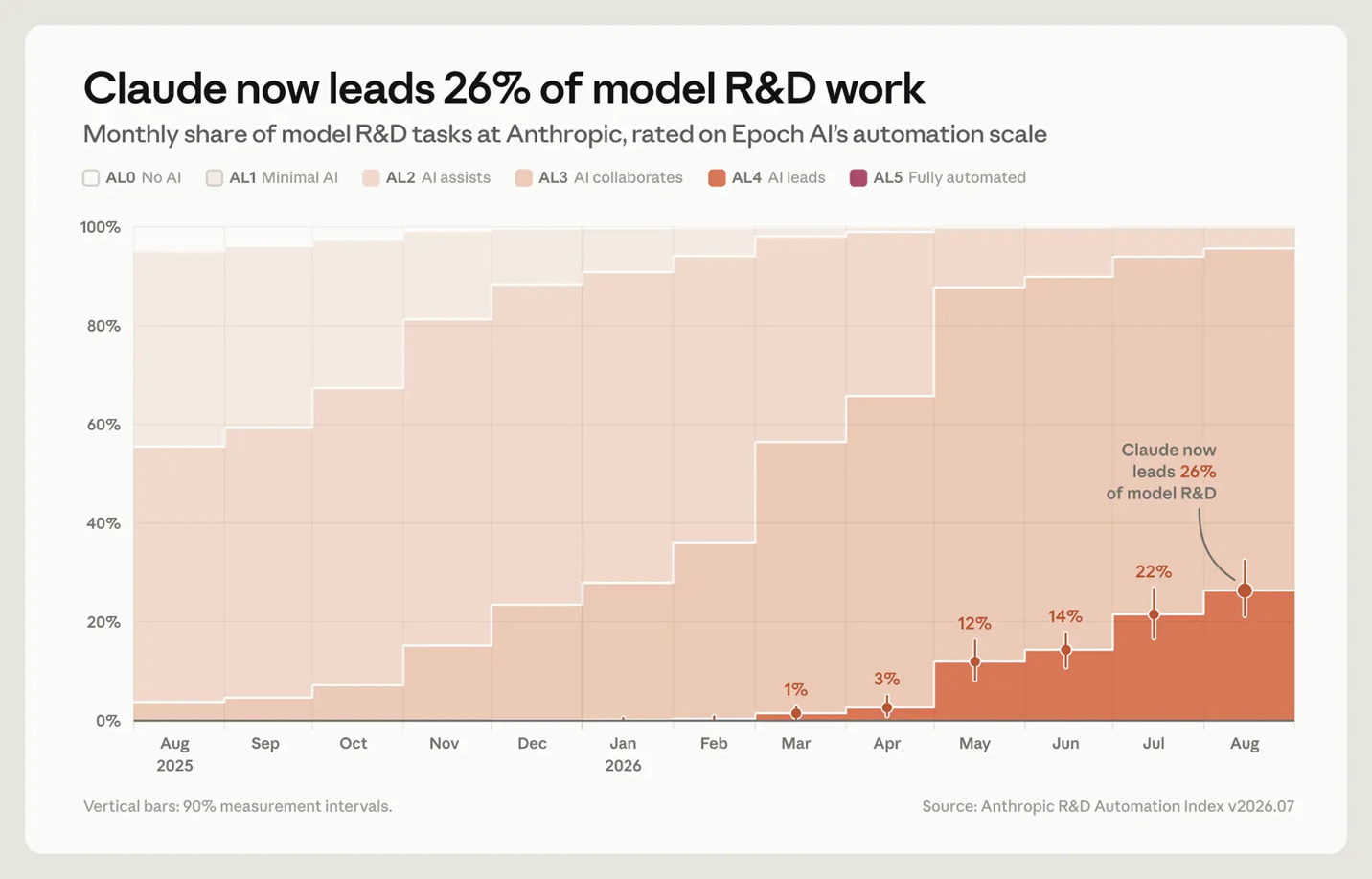
There’s another reason to internalize the frontier: if you are Anthropic, you probably believe that the highest expected-value use of frontier tokens is building your own next model. Why should you let your competitors use the most recent version of Claude to build their models if you can preferentially use it and withhold it from them? So Anthropic may not be all that disappointed if they lose a bit of revenue by withholding the frontier from their clients; they get to redirect those frontier models to important Anthropic business – building ASI. As of August 2026, Claude now “leads” 26 percent of model R&D work, according to Anthropic data. If you believe that recursive-self improvement (clearly already underway) means that whoever reaches a certain capability first ends up winning forever – Nick Bostrom’s “singleton” – then you probably think your best model is best employed building the next model, and nothing else.
3) Why sell the shovel if you can keep the gold?
There’s another good reason to widen the public/private frontier gap, which is to get preferential access to new discoveries. A year or two ago, people were still accusing LLMs of being “stochastic parrots” and were fond of saying “if they’re so smart, where are all the discoveries”? Now that the frontier labs are producing genuinely novel mathematical results, these models aren’t being accused of that any longer.
If Claude becomes adept at creating valuable IP – most obviously through biotech – it makes no sense for Anthropic to capture only a minuscule portion of this revenue. A query that might cost a pharmaceutical company a couple thousand dollars could become a multi-billion-dollar patent portfolio. This creates an incentive to turn that asymmetry on its head. Anthropic is selling the shovels right now when they could commandeer the entire mine and extract the gold themselves.
Can Anthropic gain the internal capability to make biotech discoveries? They seem to think so. Dario has written many times about his belief that AI can find the cures to many diseases. I believe him.
The way I believe this develops is that both OAI and Anthropic stand up internal research functions to generate cutting-edge IP in a variety of fields – drug discovery, materials science, battery technology, pure math, chip design, quantum computing – and partner via JVs with firms in cases where talent is extremely specialized and unwilling to join.
Revenue from these initiatives will be unpredictable, lumpy, and may take years to manifest, but I believe it will be a meaningful line item alongside selling tokens. I think the investing public will realize this and update their model of how these firms monetize when their S1s come out.
For this strategy to work, OpenAI and Anthropic are strongly incentivized to keep the private frontier well ahead of the public frontier. Perhaps the two will never converge ever again.
Pacing solves the prisoner’s dilemma
The trouble is, if one lab unilaterally paces, the other can gain massive market share by defecting and releasing their frontier model to the public.
In other words, Anthropic and OpenAI as the two leading labs are locked in a straightforward prisoner’s dilemma. The firms must collude if they are to pace. Dario inelegantly gestured at this in his now infamous blog:
Therefore, in parallel with the regulatory route, AI companies can and should voluntarily work together to set standards — a process that I believe will go better with the verifiability provided by permanent embedded evaluators. For antitrust reasons, it’s helpful for the US government to mediate or at least enable these discussions — they don’t need to participate, but do need to issue a narrow waiver for certain kinds of safety conversations.
Why would Dario ask for an antitrust waiver? Taken to its logical conclusion, coordinated pacing could mean that the major AI firms voluntarily restrict the supply of frontier intelligence to the public – an arrangement with an uncomfortable resemblance to a producer cartel like OPEC. This is perhaps why his pacing call was not well received in DC.
This suggests that Dario’s proposed solution to the Safety concerns that have cropped up lately is coordination among competitors, which is why he asked for an antitrust waiver. Ordinarily, firms don’t need an antitrust waiver to behave responsibly and share safety information; the exposure is much greater when they are meaningfully coordinating.
For the industry-wide internal frontier to stay well ahead of the public frontier, Anthropic needs their competitors to exercise comparable restraint, and for that they need either full-on regulation or this kind of voluntary cartelization he is describing.
Dario even seems to imply that he intends to widen the gulf between the public and the private frontier in the essay:
To be clear, pacing does not mean halting model training or technical progress, but ensuring companies take adequate time to align and safeguard their models, and for third party evaluators to confirm this
Summing up
Dario does not need to be lying about his Safety concerns for this interpretation to be true. It could simply be the case that a focus on Safety happens to be extremely convenient for Anthropic in the context of widening the private-public frontier gulf.
Or, in the more cynical telling, the labs are panicking about the impact of distillation on their margins and have workshopped ways to move away from the “token merchant” business model, belatedly realizing that the most valuable customer for frontier intelligence may be themselves.
Either way, I believe both Anthropic and OpenAI are using this crisis as an opportunity to explore a verticalization of their business models – away from semi-commoditized token sales and towards capturing the downstream value their models create.
“Pacing the frontier” takes on a different meaning if the frontier being paced is only the one available to the rest of us.
The most enlightened insight I have seen on the subject.