

Both myself and my firm Castle Island are investors in some of the companies mentioned in this study, most notably CoreWeave and Crusoe.
In the debate about whether data centers justify the cost and the nuisance, the critics often point out that there’s a difference between the ordinary datacenters of yesteryear and the hyperscale datacenters being built today.
It’s reasonable, one might suppose, to not even notice an ordinary 5 megawatt Equinix datacenter next door, while objecting to the construction of a massive 1 gigawatt datacenter with onsite gas generation.
People have a lot of complaints about data centers, some more valid than others, but the one incontrovertible issue that strikes me as most important is neither water, nor residential electricity rates (covered here), or any other more speculative concern, but noise.
Massive industrial scale HVAC units are loud. Gas turbines are louder. If the datacenter is going “behind the meter” and generating its own power on site, it adds another noise source. Gas turbines are close cousins to literal jet engines. An unsilenced aeroderivative industrial turbine can exceed 100 dBA.
So what is the nuisance profile of America’s largest datacenters?
As it turns out, despite this being an intensely political issue with a simple empirical answer, no one knows. No one has systematically studied it, as far as I can tell.
There is shockingly little data regarding the noise impact of hyperscale (let’s just define it as 100 MW and up) datacenters. The state of Virginia made a couple measurements. Individual projects sometimes include anticipated noise estimates to satisfy local ordinances. Residents sometimes record ad hoc videos on their phones. There have been a few one-off studies of individual datacenters. But there has been nothing systematic. Surprising, given how easy it would be to run a noise study of America’s largest datacenters.
So because I don’t have time to personally canvass the Midwest and rust belt and set up acoustic monitoring equipment, I decided to estimate data centers’ noise footprint from satellite imagery, proximity to residential clusters, and land-use application documents.
For this study I examined the 25 largest currently operating AI data center campuses in the United States (according to Epoch). For each, I mapped the likely operating-noise sources, identified the nearest cluster of at least five residences, measured the separation, and devised a noise estimate along with other factors. I then reviewed public reports of noise complaints, litigation, and mitigation effort to see if the record of complaints matched the estimated noise levels.
I found neither universal quiet nor universal disturbance. For 17 campuses, I found no credible current complaint attributable to ordinary operating noise. Four had limited allegations or residual concerns following mitigation. Microsoft’s Fairwater Atlanta had credible complaints from multiple households, warranting a higher concern score. Three campuses – SpaceXAI Colossus 2, Meta Prometheus, and Google New Albany – had the strongest evidence of ongoing problems, including official acknowledgment and continuing mitigation efforts.
Those three campuses share two conspicuous characteristics: they are extremely large (over 450 MW), and the noise sources are less than 500 meters from residential clusters. Additionally, two of the three (Colossus 2 and Prometheus) have onsite gas generation.
Merely building a large data center is not a guarantee of creating a noise annoyance. Amazon’s New Carlisle is the second-largest in the sample with 910 MW of active power and it got my lowest reported noise concern score with virtually no public complaints.1 Larger and more resident-proximate datacenters were more likely to yield community complaints, but it’s entirely possible to site a >500 MW data center within a kilometer of a population center without creating evident issues.
My conclusion from this study is that extremely large scale hyperscale datacenters can coexist with local populations amicably if the right mitigations are in place. No data center further than 800 meters from the nearest population cluster had any meaningful documented complaints. Adding behind the meter generation – as many datacenters are now doing in response to concerns about power bills – increases the risk of noise annoyance. This is an irony of datacenters trying to address concerns about “using up” grid power – as they add onsite generation, they create new issues in the form of noise from turbines.
It’s quite possible that we will witness a wave of noise complaints in the coming months if more datacenters follow XAI’s Colossus 2 template and add local generation. Conversely, it’s easy to predict when data centers will encounter community complaints, political criticism, and lawsuits. In my view, data center noise is an operational challenge that can readily be mitigated, rather than an inescapable flaw of hyperscale data centers.
Of course, my satellite estimates are not a substitute for genuine acoustic surveys, and they should not be taken as such.
Satellite analysis and methodology
My sample for this survey was the 25 largest currently operating data centers in the US, according to Epoch.
The largest of these is SpaceXAI’s Colossus 2 near Memphis, TN, with an estimated 946 MW of powered capacity. This also happens to be the most problematic one. Elon plans to grow it to over 1.5GW in the next year.
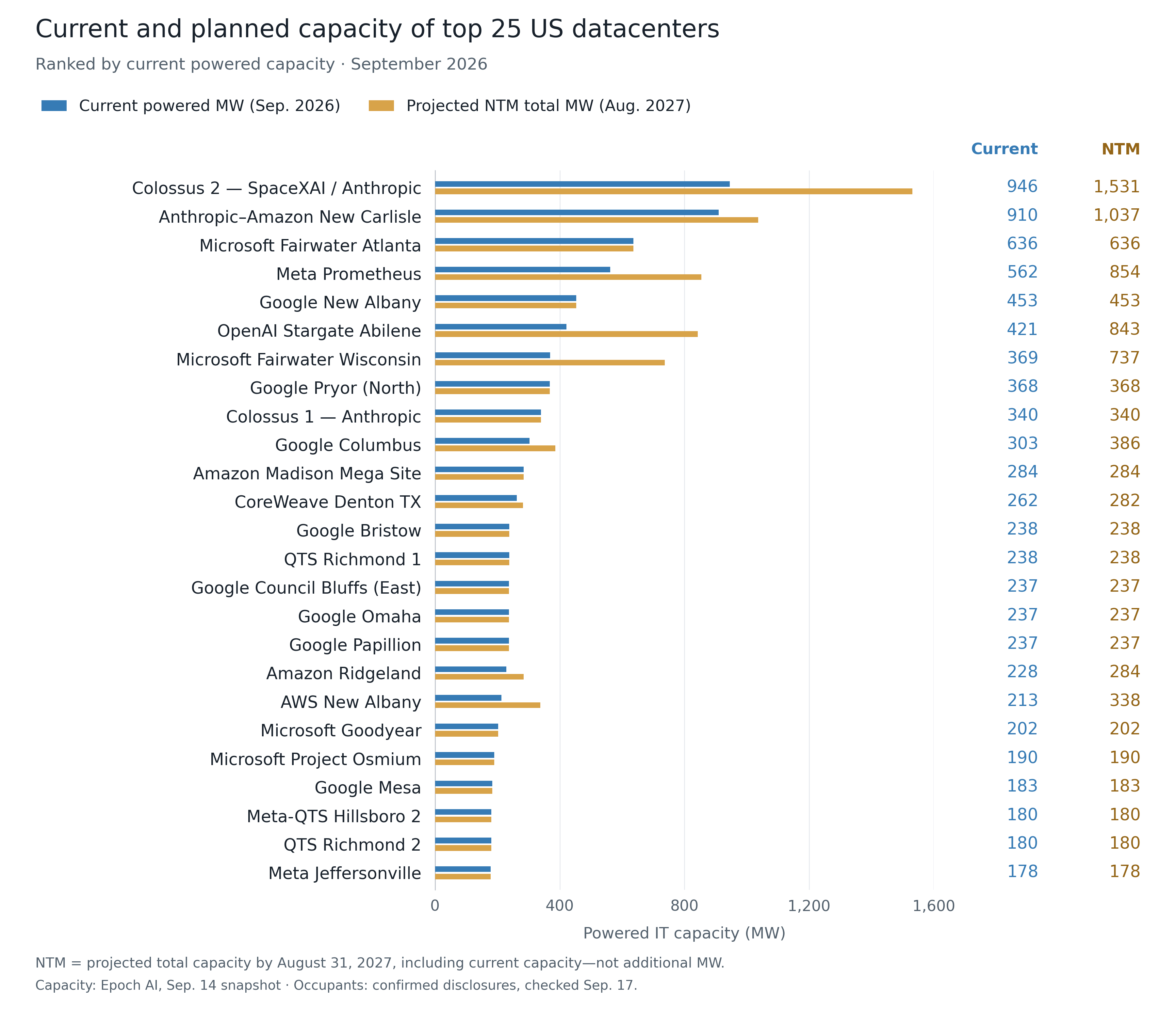
My approach for this study was straightforward. I combined up-to-date satellite imagery with planning applications to determine which data center components were noisiest, and then traced the distance from those noise sources to the nearest residential cluster, defined as a minimum of five homes. In several cases there are isolated residences that are closer to the data center, but I used a cluster, because I’m more interested in the average close neighbor’s experience, and I’m less likely to make a mistake if I am looking for at least five roofs. I am aware that this might be a controversial choice, but I didn’t want to find the absolute worst-off individual; I wanted the worst-off neighborhood.
A lot of complaints concern traffic or construction noise; those are temporary and not data center specific, so I didn’t focus on them, even though they can be real nuisances. I was only interested in steady-state operational noise.
Here’s an example of a satellite analysis for SpaceXAI’s Colossus 2 facility:
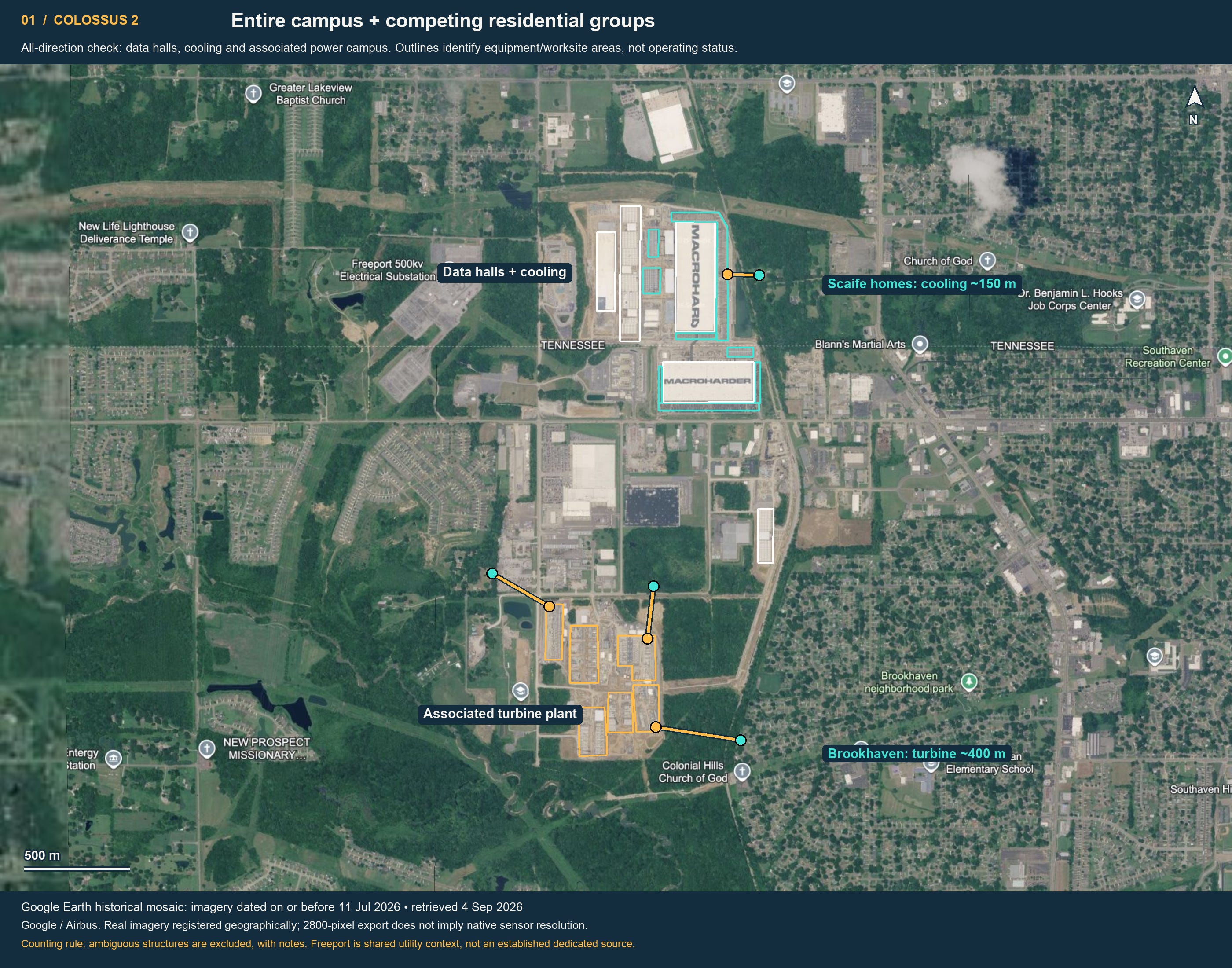
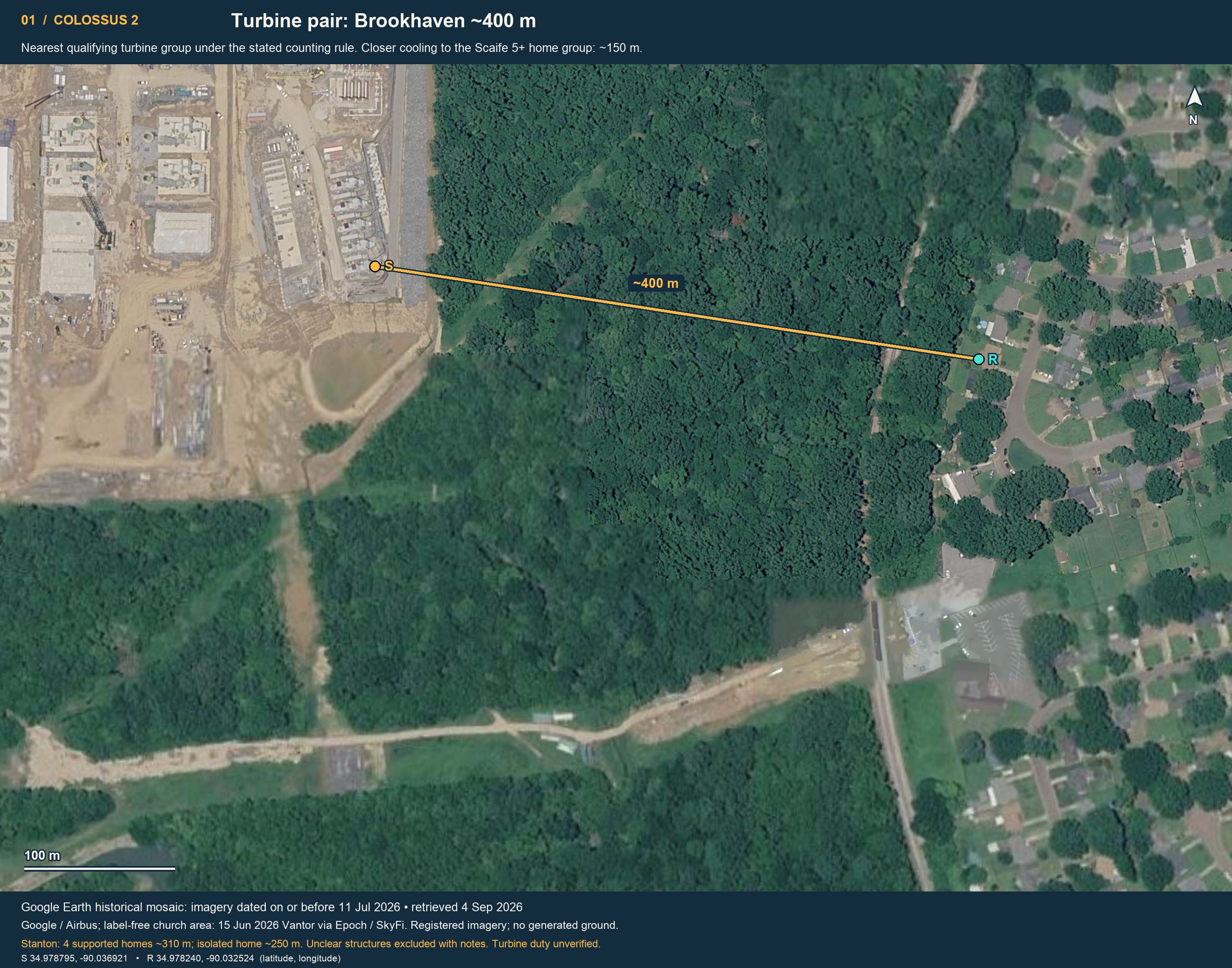
Here you can see two distinct sources of noise facing two qualifying residential clusters: the cooling equipment outside the main GPU hall which is 150 meters to the nearest cluster, and the 69 temporary turbines to the south of the facility, 400 meters from the Brookhaven neighborhood. Both have the potential to exceed problematic noise thresholds.
They’re not all like this. Google’s Storey County data center in Nevada, ranking 27th overall (not in my main sample of 25) with 161 active MW (rising to 300 MW next year), is 10.4 km from the nearest residential cluster.
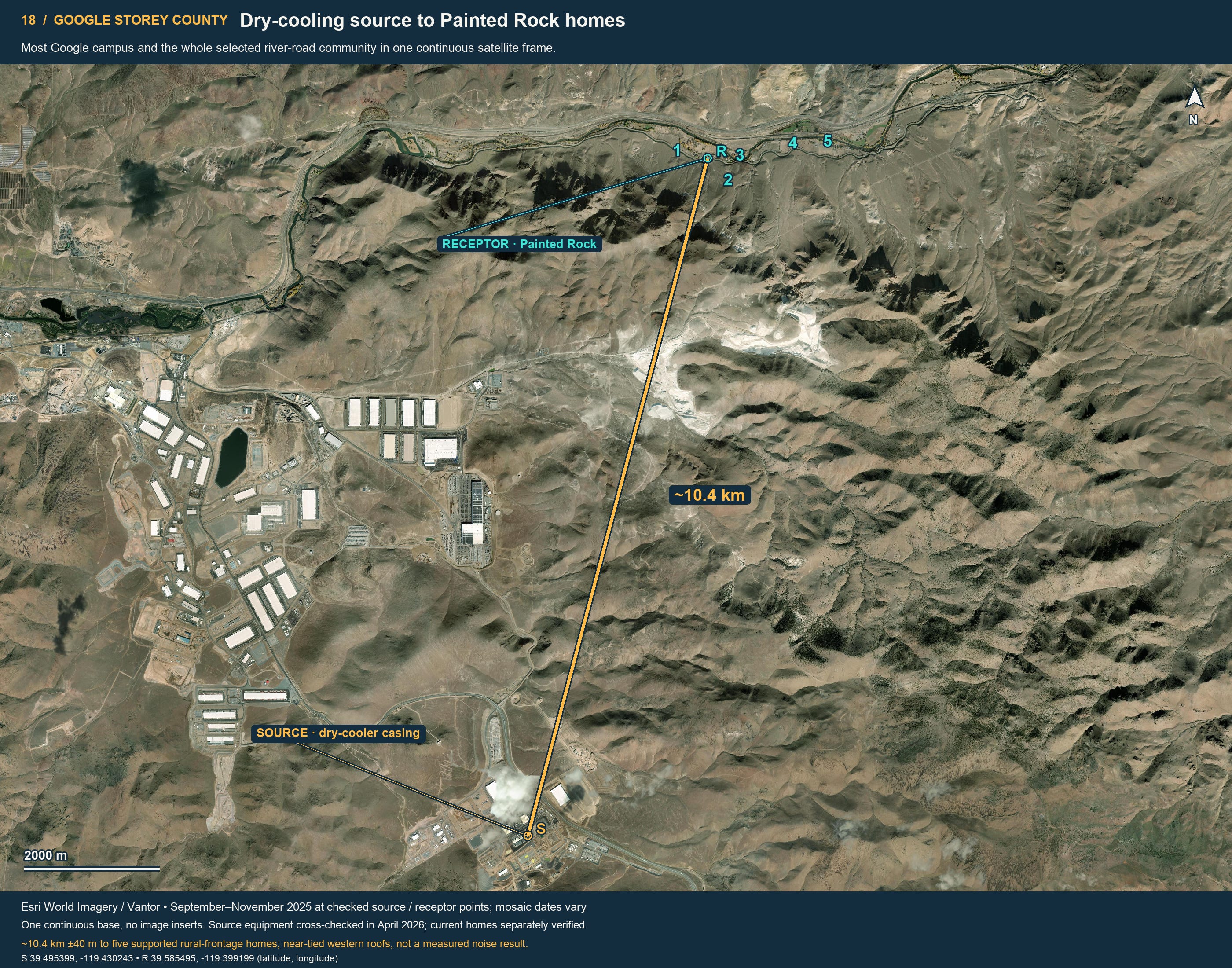
Because of the backlash faced by suburban-adjacent data centers like Colossus 2, the current trend is towards more rural siting locations. Of the 66 GW of data centers currently under construction in North America, 77 percent is located in emerging frontier markets, with West Texas the largest beneficiary.
But as I conducted my survey of the 25 current largest data centers, I will admit I was shocked by how small the separation to residential neighborhoods was in many cases. Of the 25 data centers surveyed, 11 were located less than 500 meters from the nearest residential cluster. AWS New Albany, a 213 MW datacenter in Ohio, has coolers only 90 meters from the nearest residential cluster.
Once I had measured the distance between noisemaking equipment and residential clusters, I wanted to see if the distances correlated to registered noise complaints or lawsuits. To determine whether a noise concern had been documented, I developed a five point score quantifying the strength of the complaint record.
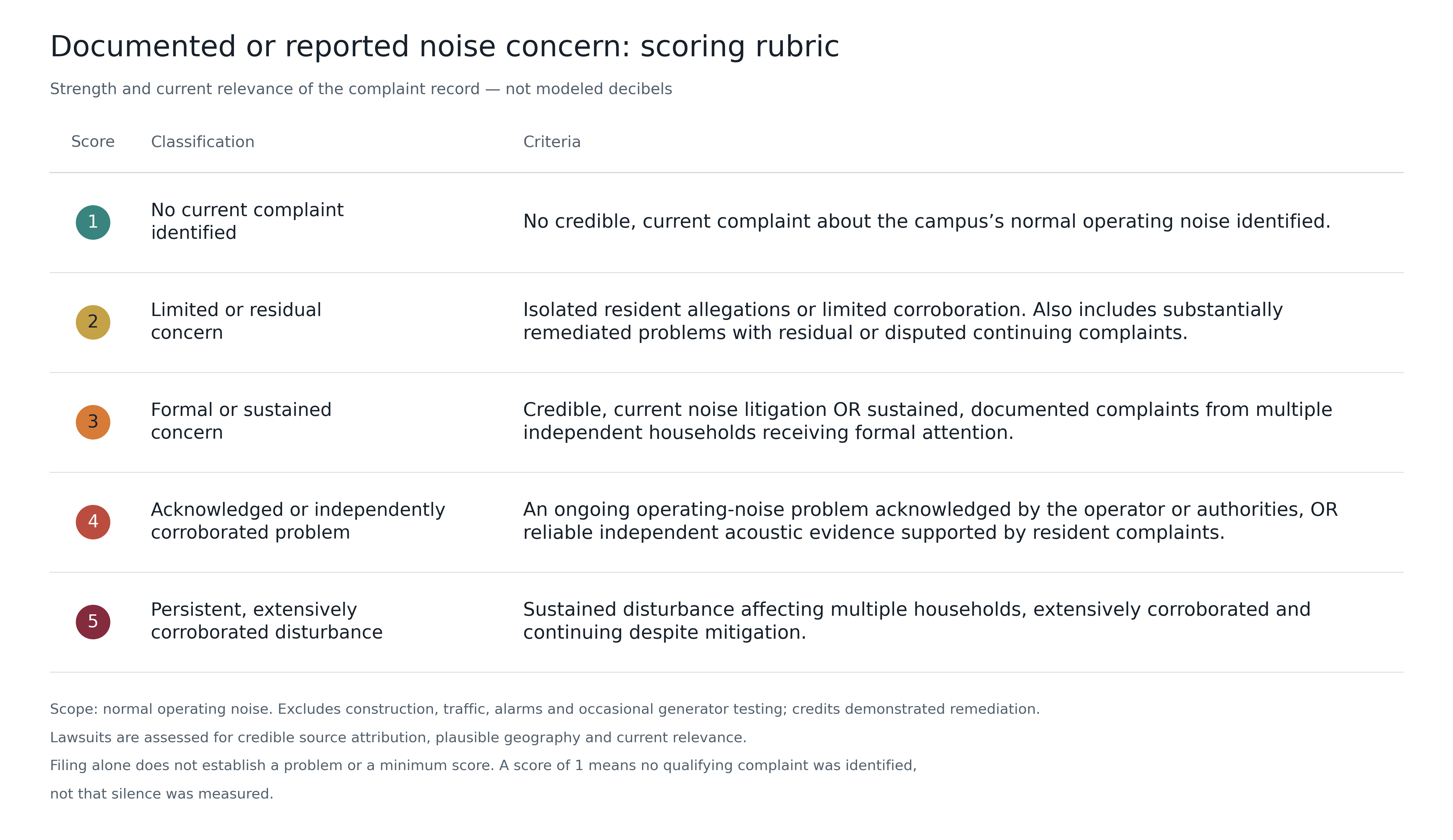
A score of 1 doesn’t mean there’s no noise whatsoever, just that there is no complaint evident either in the press or in lawsuit form. A 3 requires litigation or complaints from multiple different households. A 4 requires acknowledgement by the operator or authorities, or an actual acoustic study by residents. And a 5 is a severe noise disturbance that has continued despite acknowledgement and mitigation efforts.
Finally, I wanted to see if I could independently devise a decibel-level estimate of the datacenter noise at the nearest residential cluster. I wanted to get a sense for what residents might be hearing, based on the equipment type, distance from source, environment, and mitigations in place. I wanted to see if these bottom-up noise estimates might provide a useful sanity check for resident complaints.
For the decibel estimate, we started by looking at the source-receptor distance, identified the equipment type and counted the number of coolers or turbines, took into account manufacturer specifications, applied site-specific adjustments (like onsite noise dampeners), considered terrain, and calculated propagation from the equipment to the home based on known physics principles.2 From this we were able to make an educated guess as to steady-state operational noise levels at nearby residential clusters. [Note: this is not a substitute for a resident’s actual experience with noise, or an acoustic study, but an estimate built from a highly simplified noise model!]
Keep in mind that decibels are measured logarithmically, not linearly. Every additional 10 decibels implies ten times the sound energy, but only twice the perceived loudness. Every time you double the distance from a sound source in unrestricted terrain, sound falls by about 6 dB.3 Here’s a simple reference:
20–30 dBA: very quiet bedroom / whisper territory
40 dBA: quiet residential environment
50 dBA: noticeable background noise
60 dBA: ordinary conversation
70 dBA: vacuum cleaner / loud street
80 dBA: very loud traffic / loud machinery
90 dBA: lawn mower / some power tools
100 dBA: nightclub / extremely loud machinery
The EPA says that quiet suburban daytime noise is 36-40 dBA, normal suburban is 41-45 dBA and urban residential is 46-50 dBA. If you are at home and the background noise is a quiet 35 dBA, and there’s a data center producing sound which is 35 dBA at your location, the total noise level is only 38 dBA. But auditory masking is frequency dependent. If the ambient noise is birdsong and crickets and wind, and the data center produces a low frequency constant rumble, you might still be able to make it out, even if it is quieter than the ambient noise. This is actually in line with what Virginia found in a preliminary, small-scale study:
Data centers emit low-frequency noise that is not loud enough to damage nearby residents’ hearing and rarely loud enough to violate noise ordinances. However, some nearby residents report that the constant noise generated by some data centers affects their well-being.
Results
Before I present my findings, some caveats:
The distance to residential cluster is a satellite measurement of the distance between the data center equipment I assessed as loudest, and the closest home in a nearby 5+ home cluster. There are isolated properties closer to some of these data centers
The dBA figures are modeled estimates of noise levels at the nearest residential cluster based on listed equipment specs, comparable-equipment assumptions where specifications were unavailable, estimated operating loads, measured source-to-home distances, and allowances for terrain, barriers, and mitigations. No acoustic measurements whatsoever were made for this study
The noise concern score is a simple synthesis of verified resident noise complaints, filed lawsuits, acknowledgments from operators or local authorities, and attempted mitigations
The main thing that surprised me was how close so many of these hyperscale datacenters were to residential clusters. And keep in mind my definition is a cluster of minimum 5+ residences; if I used a more conservative approach and accepted the nearest lone farmhouse, the distances would be even lower.
Before I started this project, I assumed that most of these hyperscale data centers would be over a kilometer from the nearest meaningful residential cluster. That is simply not the case, and shockingly also not true in the case of sites with onsite generation. I’ve been to a few data centers dating back to the heyday of Bitcoin mining and they were all in rural areas, but even sites I thought were super remote like Stargate Abilene aren’t that remote. Frankly, doing this analysis has made me much more sympathetic to the plight of residents who claim that these data centers are causing noise disturbances.
As you can see on the chart, all of the problematic data centers scoring 3 or higher had selected noise sources within 500 meters of residential clusters; but not all close-by data centers are problematic. This is good news for the data center operators; it demonstrates that being somewhat close to residential communities is not a guarantee of causing a nuisance.
This chart is broadly consistent with my (admittedly questionable) modeled dBA estimates; the positive correlation shows that my bottom-up guess tends to correlate with observed complaints. Though there are a few datapoints that surprised me – I modeled relatively noisy levels for AWS New Albany and Hillsboro 2 but couldn’t find any verified resident complaints.
If we divide the 25 data centers into a matrix of large/small and close/intermediate/far from residential clusters, it is immediately obvious what the problem factors are.
Virtually all the data centers over 500 meters from residential clusters had scores of 1 or 2, meaning no credible current operating-noise complaint was identified, limited allegations, or substantially mitigated concerns. Even data centers within 500 meters were largely complaint-free if they were “small” (under 400 MW).
Issues emerge when you have data centers that are both very large and close to local residential clusters. Worse still if they have onsite gas generation, either running constantly or as backup. These sites – XAI’s Colossus 2, Microsoft’s Fairwater Atlanta, Meta’s Prometheus, and Google’s New Albany – are the ones where we have an established trail of multiple credible complaints, lawsuits, acknowledgements from the local authorities and the tech companies, and attempts to mitigate.
The good news is that based on this analysis it should be really straightforward to predict whether a data center will cause a genuine noise disturbance. The bad news is that, if I had to guess, many hyperscale data centers currently under construction will fall in that problematic large/close quadrant. In particular, concerns about tech companies driving up electricity prices have led many neoclouds and hyperscalers to focus on behind the meter (onsite) generation. This basically trades one nuisance (grid strain) for another (noise). Alternatively, you could see it as shifting the burden from all the ratepayers in the local RTO/ISO to the very nearest neighbors surrounding the data center.
Case studies - top five
#1: SpaceXAI Colossus 2, 946 MW
This data center in Mississippi is by far the most problematic installation in the top 25. It’s also the largest in the US and will likely remain so if SpaceXAI’s plans go ahead. The main problem is the onsite gas turbine plant in Brookhaven that’s only about 400 meters from a large neighborhood in the suburbs of Memphis. Colossus 2’s associated Southaven power plant expanded from three mobile gas turbines in August 2025 to 69 by July 2026, placing a large generating fleet near established neighborhoods.4
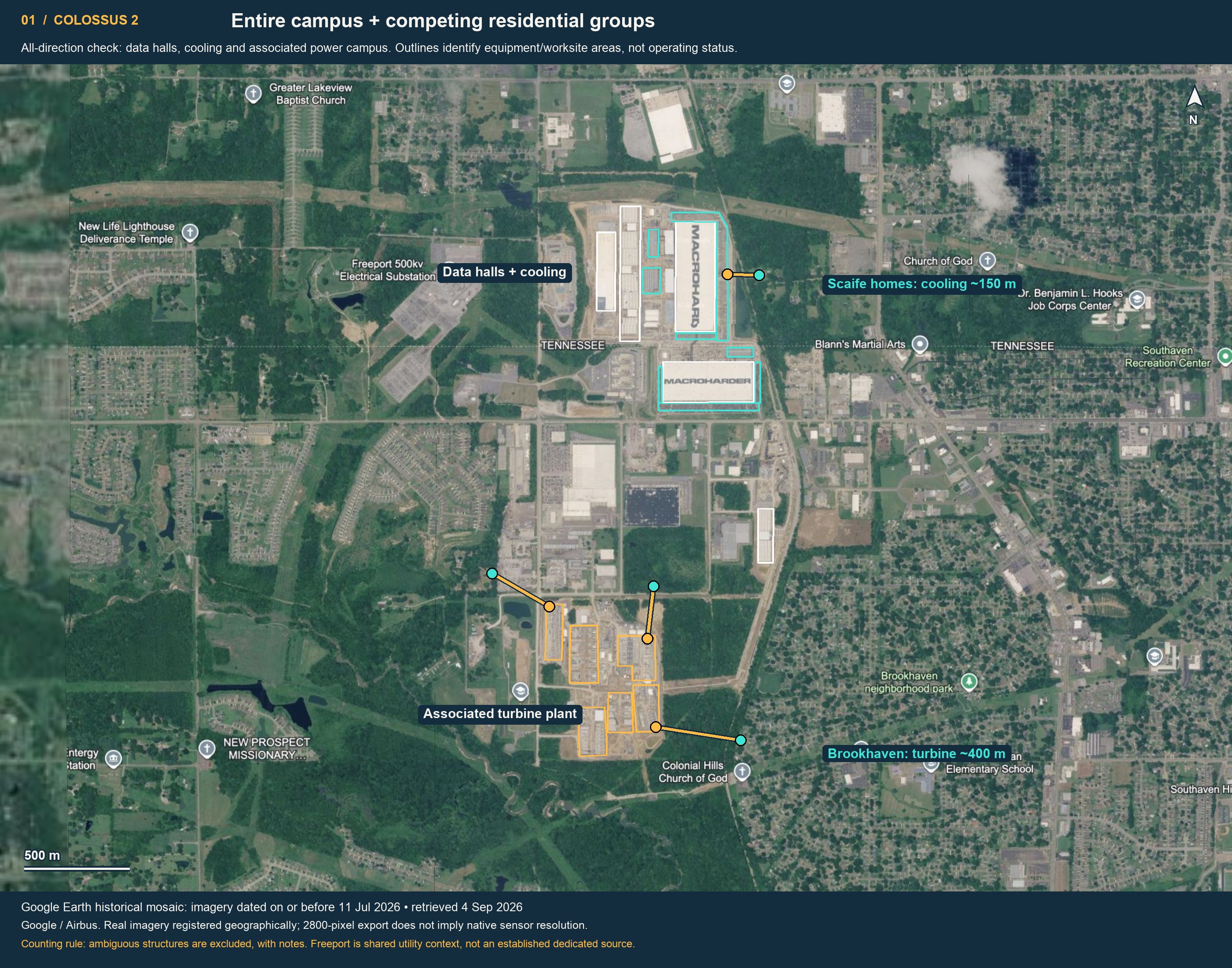
Colossus 2 gets a 5/5 noise complaint score because there have been a litany of complaints, press coverage, lawsuits, official acknowledgment, attempts at mitigation, and continuing complaints despite those attempts. Three residents filed a federal nuisance class action. These issues were officially acknowledged both by SpaceXAI and the local municipality.
Residents have described continuous roaring, whining, low-frequency rumbling and vibration, including disturbance inside their homes. Reported consequences include lost sleep, difficulty working from home and avoiding their gardens or backyards.
Other data centers following SpaceXAI’s lead here will need to be mindful of this case study and consider the disparate noise characteristics of onsite generation versus ordinary cooling.
#2: Amazon–Anthropic New Carlisle IN, 910 MW
This data center is an interesting case study because it gets the lowest score for reported noise concern. It’s 540 meters from the cooling units in the GPU hall to the nearest residential cluster, resulting in an estimate of only 46.4 dBA, even though it draws an absolutely colossal 910 megawatts of power.
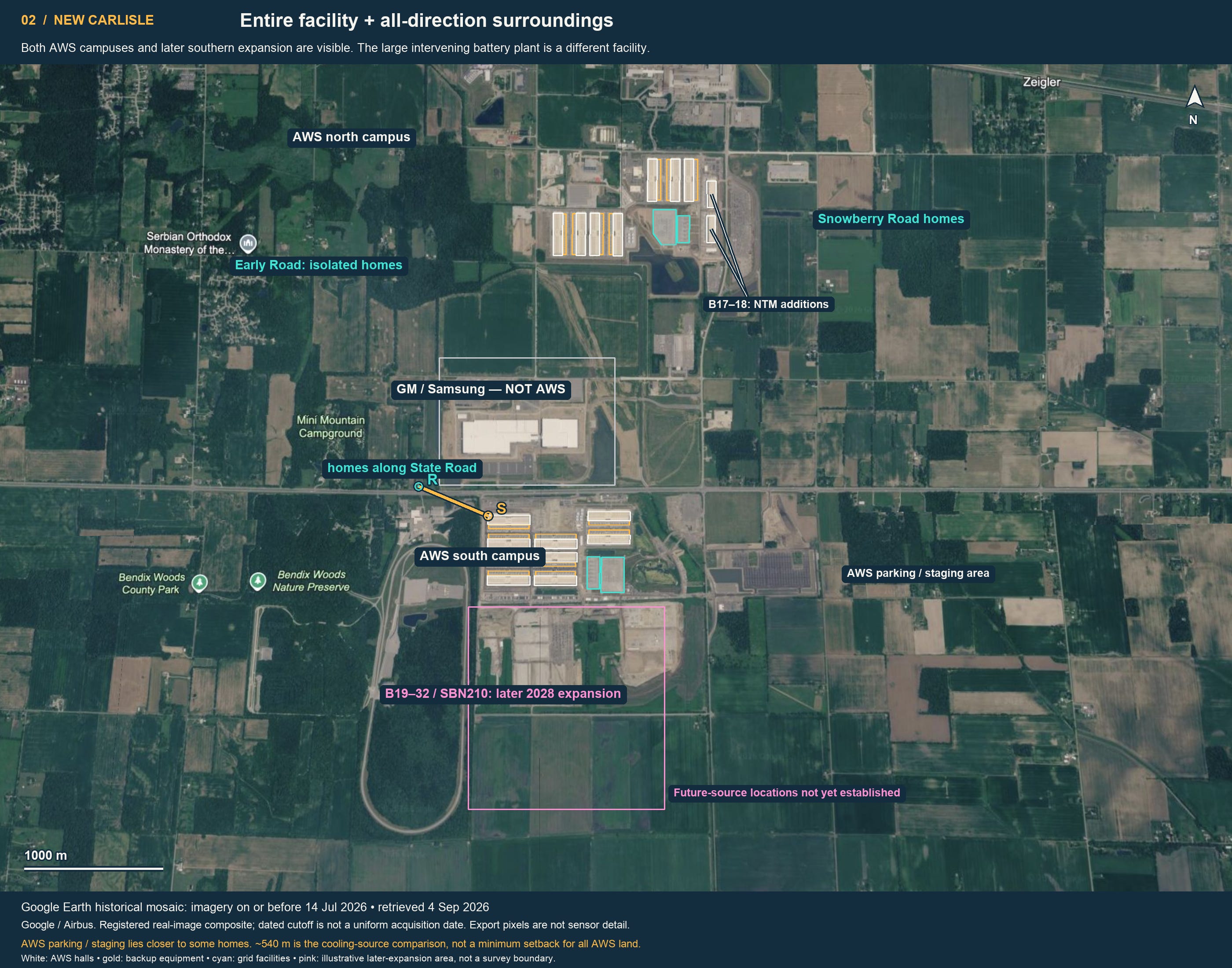
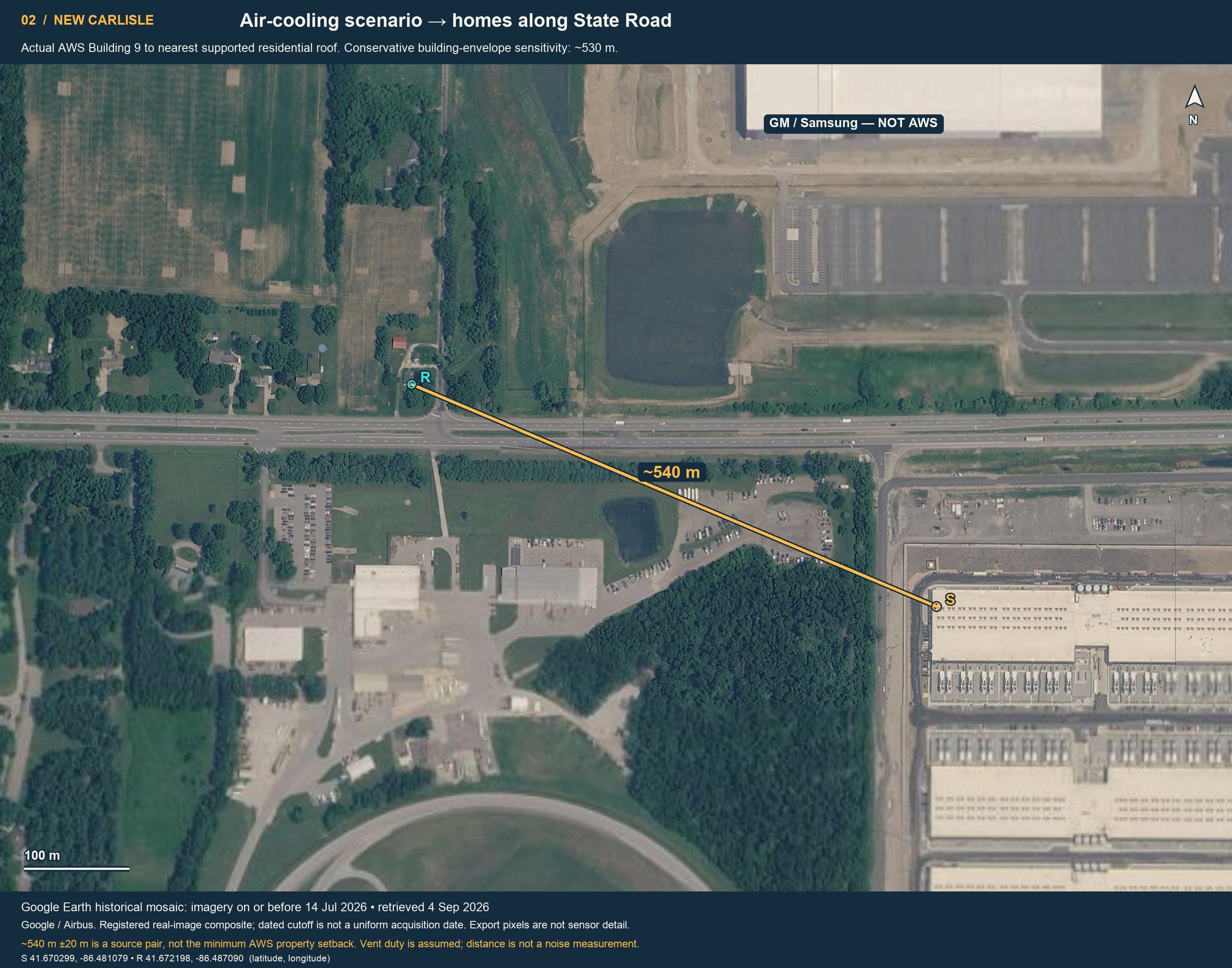
There is controversy around this project, but this relates to purported water scarcity and well failures (this is disputed), wetlands destruction, and air permit violations. There wasn’t a record I could find of complaints around ventilation noise or a filed lawsuit. This doesn’t mean that the site is quiet – just that no one has complained yet.
Even though there is enough onsite cooling to dissipate 910 MW worth of heat, the half-kilometer distance to the nearest residential cluster appears to be sufficient to attenuate the sound down to a manageable 46 dBA (my estimate). As you can see, this is a fairly rural area overall. New Carlisle is not without its flaws, but overall it seems to be a good example of how an absolutely massive data center can be reasonably benign locally.
#3: Microsoft Fairwater Atlanta GA, 636 MW
Fairwater Atlanta is a more concerning case than New Carlisle. This Microsoft campus, operated by QTS in Fayetteville, Georgia, has an estimated 636 megawatts of powered IT capacity, with the selected rooftop cooling equipment only about 160 meters from the nearest qualifying residential cluster. My model estimates approximately 59.2 dBA at the nearest home in that group – considerably higher than New Carlisle’s 46.4 dBA. This is a modeled estimate, not a sound measurement taken at the house.
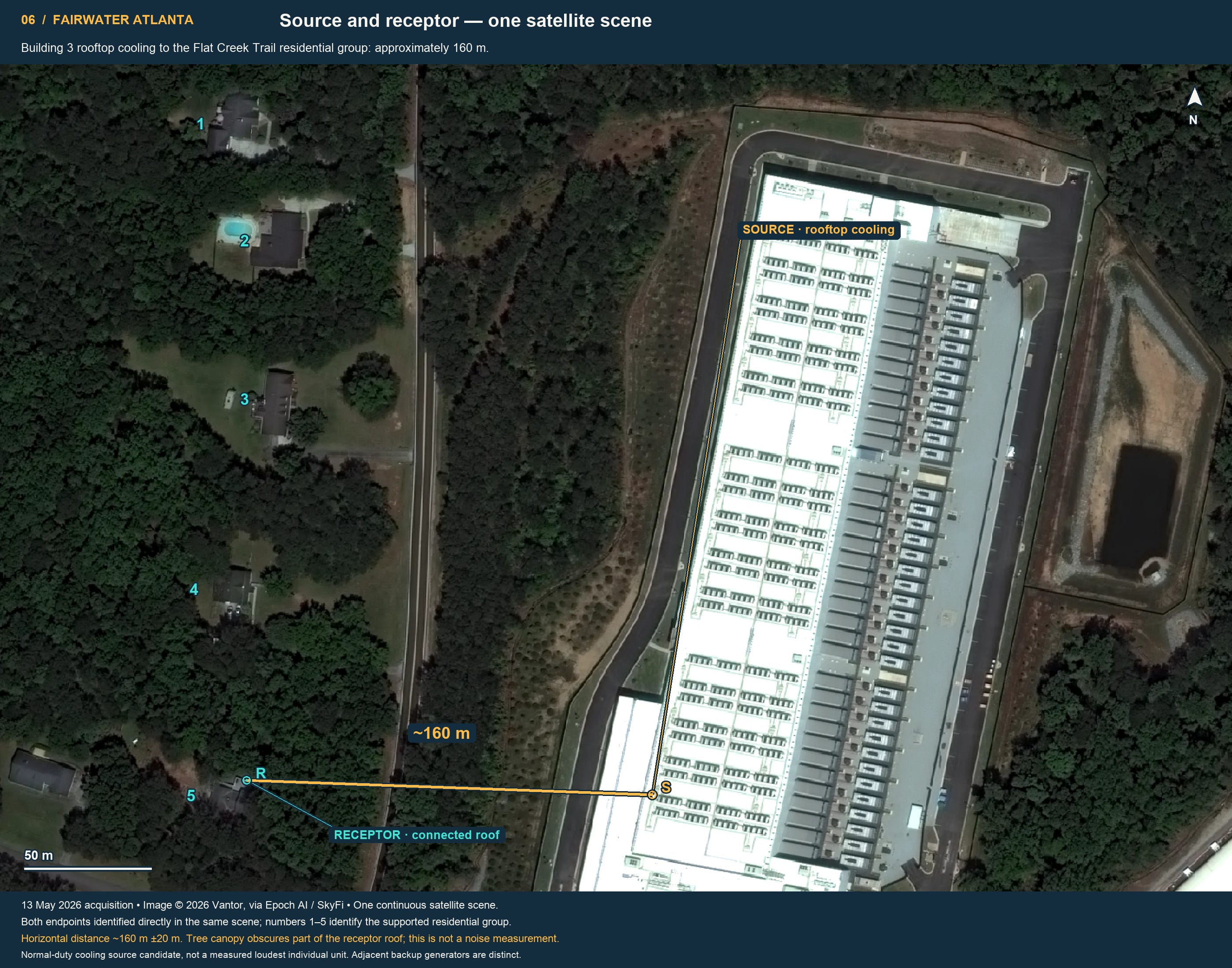
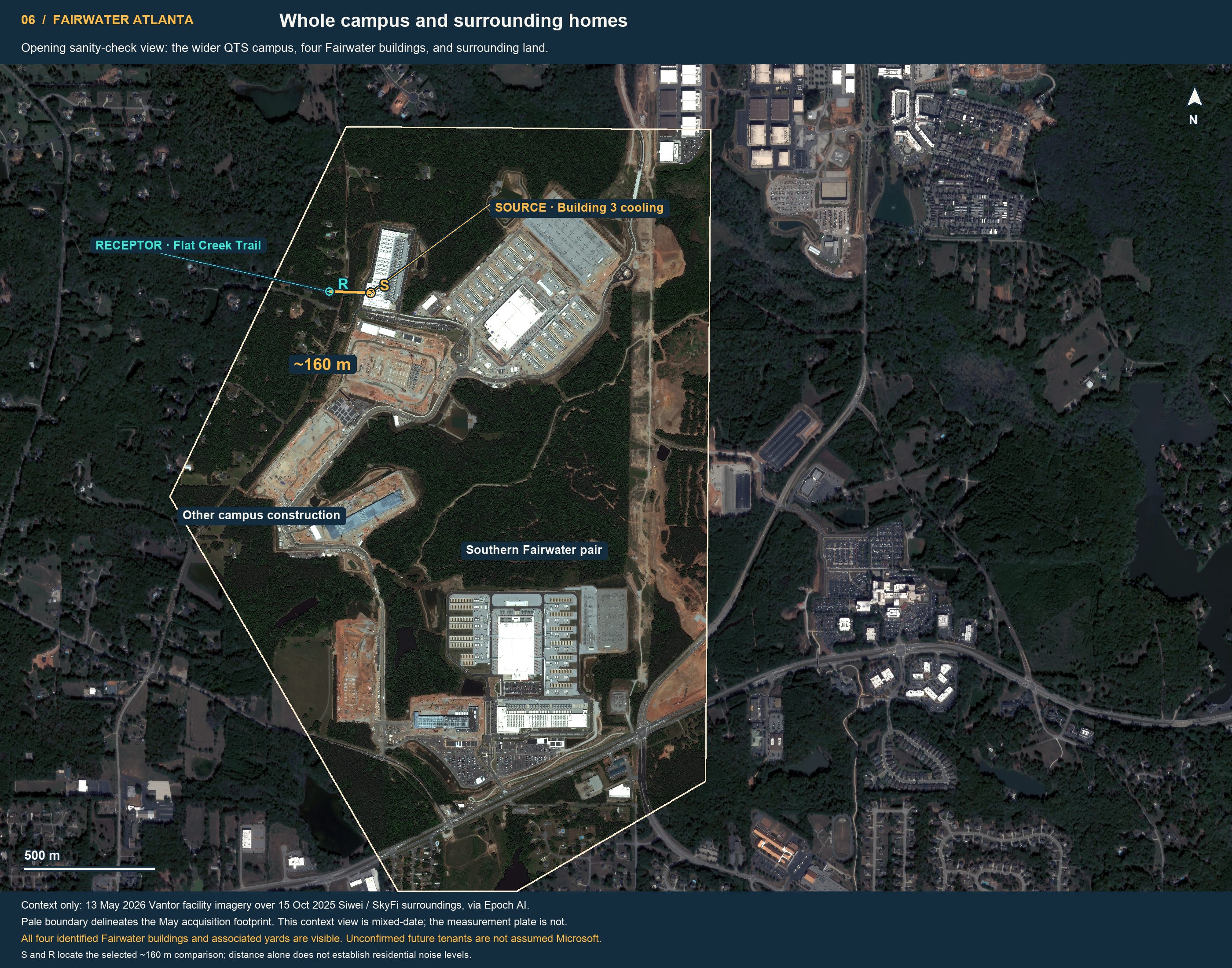
There are also credible resident complaints. Resident George Von Walthausen describes an existing constant background hum alongside construction noise, blasting and traffic. Separately, the Marschall household issued a formal demand to stop nuisances including “construction and operating noise,” vibrations and light pollution. I haven’t verified a subsequently filed noise lawsuit, but the two independent household accounts and formal legal attention support a 3/5 reported-noise-concern score.
Fairwater is a good example of how a large hyperscale data center that relies only on onsite cooling can nevertheless create noise issues if it is sufficiently close to residential clusters.
#4 Meta Prometheus New Albany OH, 562 MW
Meta’s Prometheus campus in New Albany, Ohio, combines enormous computing capacity with a close residential interface. It has an estimated 562 megawatts of powered IT capacity, and the selected southern gas-turbine installation sits approximately 220 meters from the nearest home in the mapped residential cluster. My model estimates 56.9 dBA from gas generation, including an allowance for the sound wall, with cooling separately estimated at 48.3 dBA at the same homes. These are modeled contributions, not measured sound levels.
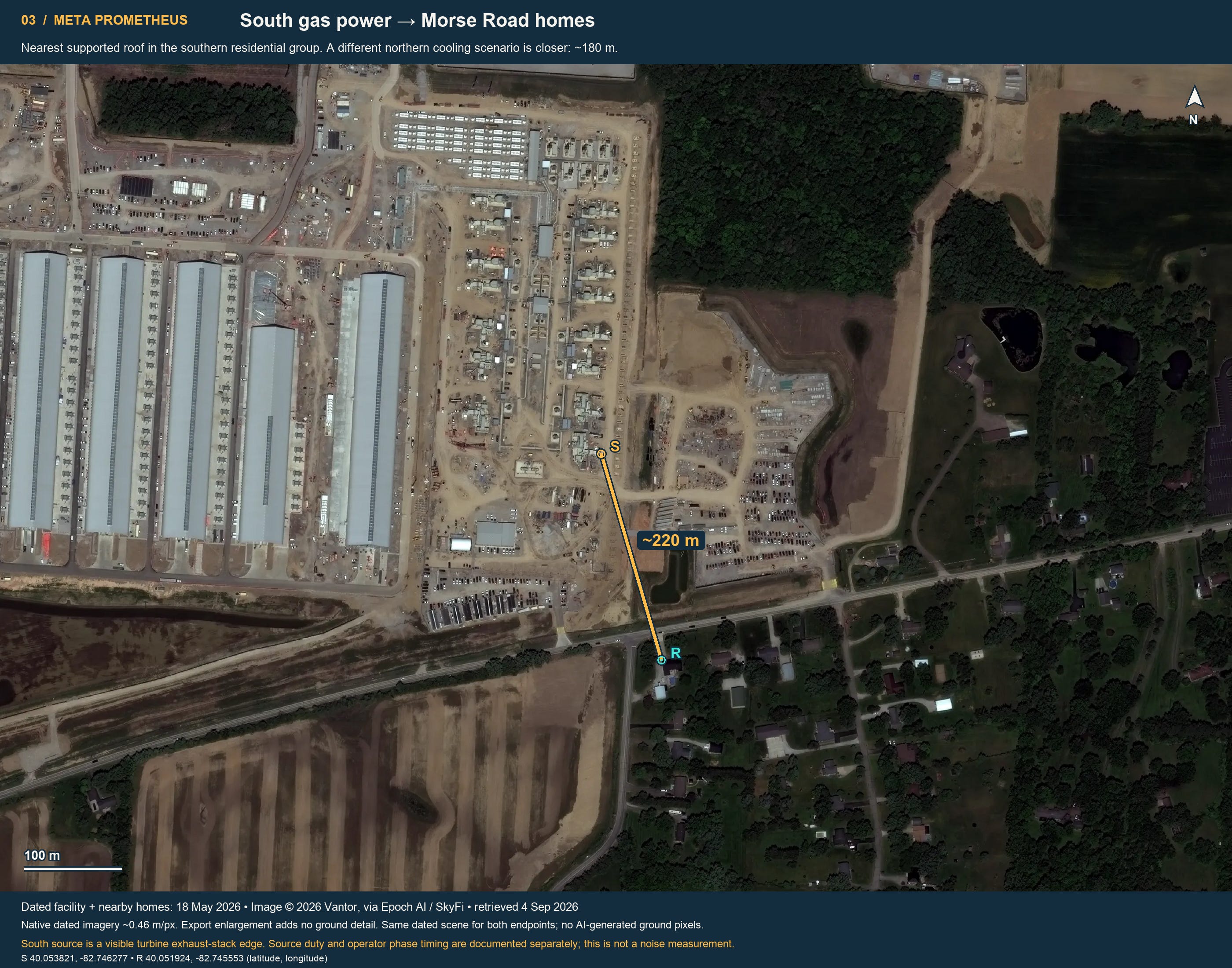
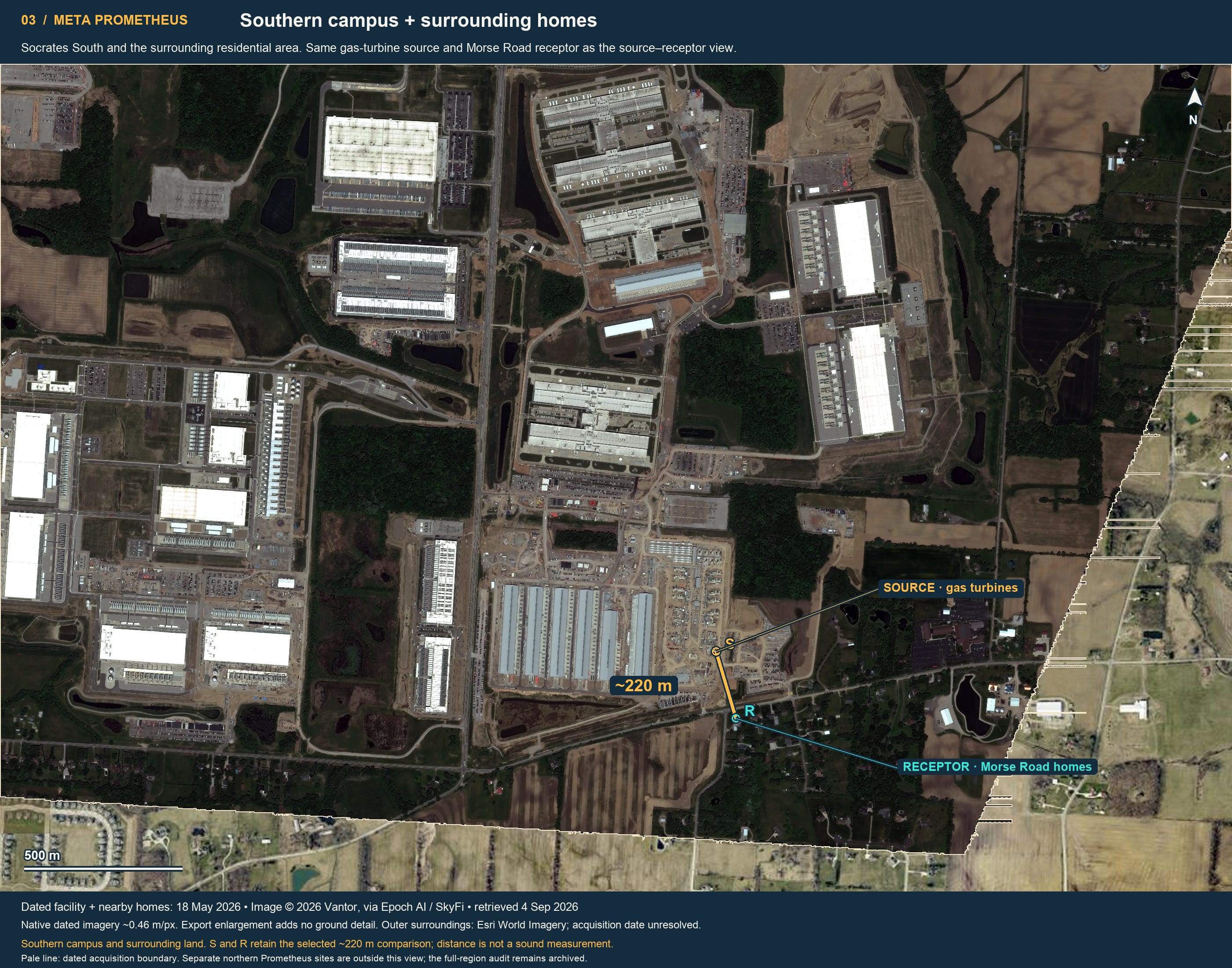
There is a documented operating-noise problem. In July 2026, New Albany received complaints about periodic noise from Meta’s campus south of SR-161 after a temporary sound wall was removed. The city and Meta agreed that the wall had come down too soon. The response includes rebuilding the Morse Road wall, increasing fan speeds in phases rather than simultaneously, and installing sound-attenuating equipment. This is stronger evidence than general opposition to development: the authorities acknowledge a problem, and the operator is taking specific corrective measures.
That supports a 4/5 reported-noise-concern score, even though I can’t find a noise lawsuit. An important distinction is that the documented complaints implicate fans, while the main satellite comparison below measures the southern gas plant’s proximity to homes. The complaints therefore don’t validate my turbine estimate.
#5 Google New Albany OH, 453 MW
A mere 1.4 miles down the road from Meta Prometheus is Google’s campus, also in New Albany. It boasts 453 MW of powered IT capacity, with the selected cooling towers only 240 meters from the nearest home in the mapped residential cluster. As you can see, the data center is ringed by suburban subdivisions on two sides. My model estimates 47.9 dBA there, but the documented complaints show why a modeled average cannot fully describe residents’ experience.
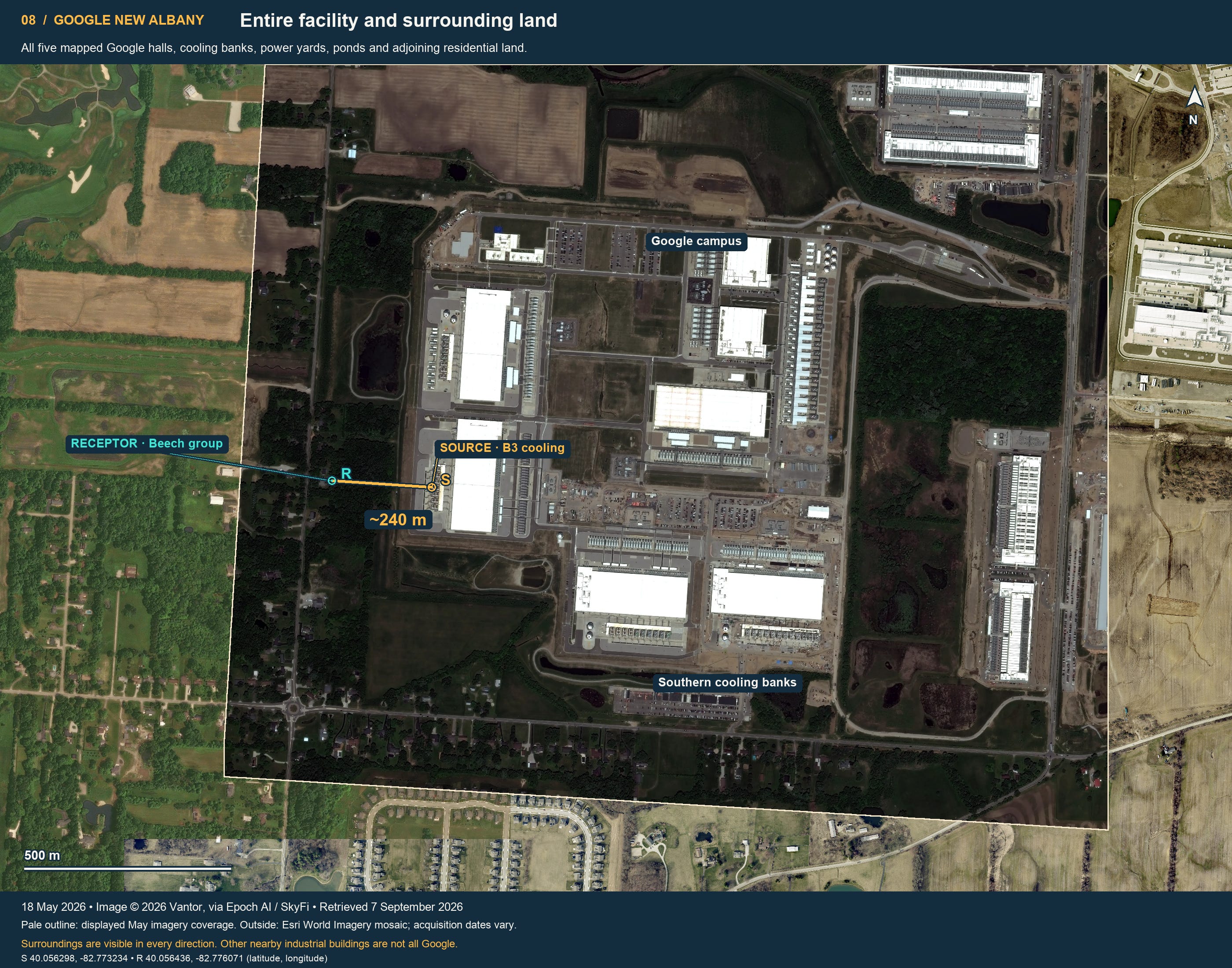
The campus receives a 4/5 reported-noise-concern score according to my rubric. Residents began reporting cooling-fan noise in September 2025; Google acknowledged the problem and introduced monitoring, operational adjustments and sound-dampening materials. The city says a permanent remedy is scheduled for completion in December 2026. I haven’t verified a filed noise lawsuit, but official acknowledgment and continuing remediation support the rating. After researching both the Meta and Google case studies, I understand why data centers are such a political flashpoint in Ohio.
Case studies - rural sites
In my opinion, the data center buildout will go one of two ways as it runs into concerted political opposition and power scarcity dynamics:
Hyper-rural sites with behind the meter generation
In this world, data centers like OpenAI’s Stargate in Abilene Texas become the template: in the middle of nowhere, with onsite gas generation, so they don’t have to draw from the grid. The increased noise created by onsite generation is offset by remoteness. Texas' data center moratorium is already pushing neoclouds in this direction. Because a lot of the slack in various grids has been absorbed already, as we wait for a very slow power infrastructure buildout, many operators will be impatient and push for behind the meter generation. Of course, there are bottlenecks here too, like a real scarcity of turbines. But the clouds will, I am sure, find creative ways to build power quickly. If this does happen, it will only be in red states. The anti-AI sentiment is too advanced among Democrats and I don’t believe politicians will be willing to stomach concerted local opposition in exchange for tax benefits.
Micro data centers / sovereign compute
In this world, massive 1GW+ data centers become a fantasy as local opposition simply proves too difficult to overcome. The political costs of massively expanding the grid and imposing construction and operating burdens on local communities combined with fears of AI misuse or misalignment defeat America’s reindustrialization. But demand for AI doesn’t go away. Clouds adopt the posture of building much smaller data centers – perhaps a few tens of MW each, or even smaller. The total supply of domestic compute keeps growing, but massive 1 GW data center campuses become a thing of the past.
For now, there are still enough ultra-rural sites with spare power capacity to go around. And not every red state governor has given in to anti-AI populism… yet. Here are a few examples of the rural or hyper rural siting approach from within the sample of 25:
#6 OpenAI Stargate Abilene TX, 421 MW
This is my favorite data center just because it’s so visually striking with its massive cloverleaf pattern. I also enjoy the juxtaposition between its absolutely gargantuan scale and the charming small town Texas setting.
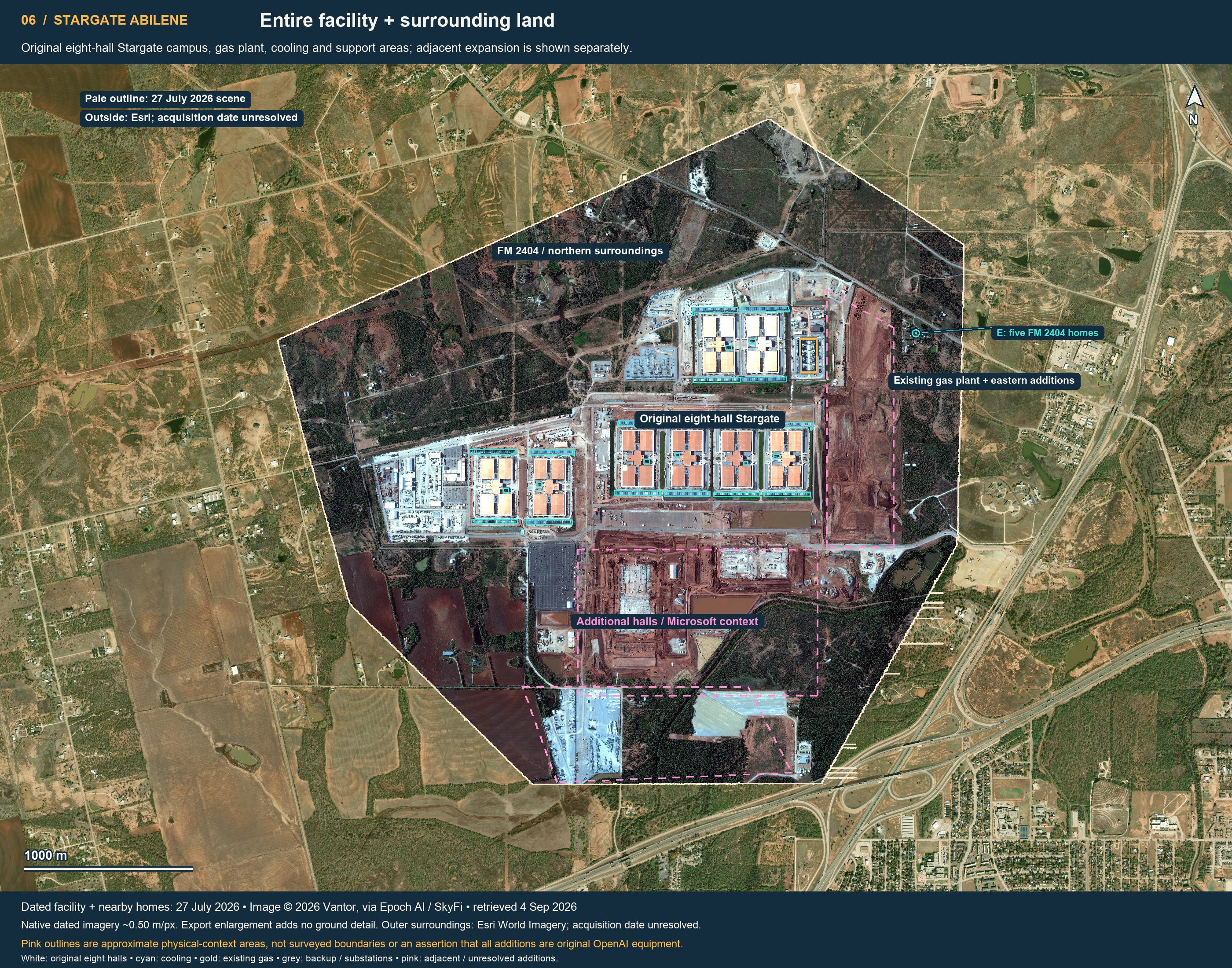
When I did my analysis I was surprised, therefore, that it wasn’t quite as remote as I had thought. Even though it is in a very rural setting overall, the nearest residential cluster is half a kilometer away (from the gas turbines).
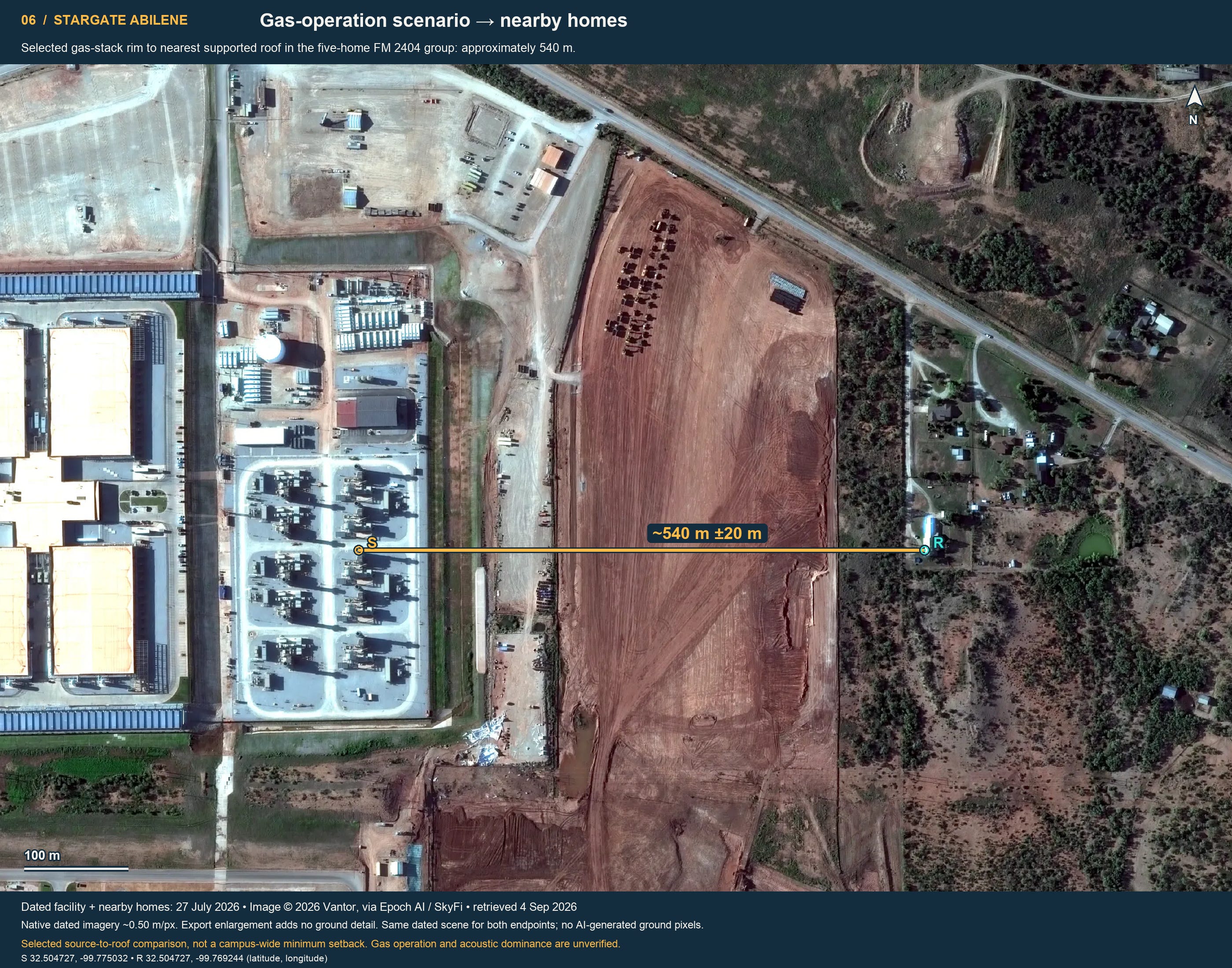
Crusoe’s announced plan covers eight buildings, approximately four million square feet, and 1.2 GW of facility capacity (though it only clocks 421 MW as of today). The important complication here is the onsite gas plant. The permit application lists ten existing turbines: five Solar Titan 350s and five GE LM2500s. Crusoe describes gas generation as providing temporary bridge power while grid infrastructure catches up, with a longer-term backup role. That makes turbine noise relevant, although I haven’t established how frequently the individual units operate. I am modeling the cooling as the primary noise source in this case, because I was unable to verify gas runtime.
In my imagery review, the selected turbine stack is approximately 540 meters from the nearest house in a qualifying five-home group. At that residential location, my model estimates 49.2 dBA from cooling, 55.3 dBA from the conditional gas-generation scenario, and approximately 56.2 dBA with both operating together.
I was able to identify documented noise complaints and some press coverage, giving it a noise concern score of 2/5.
#15 Google Papillion NE, 237 MW
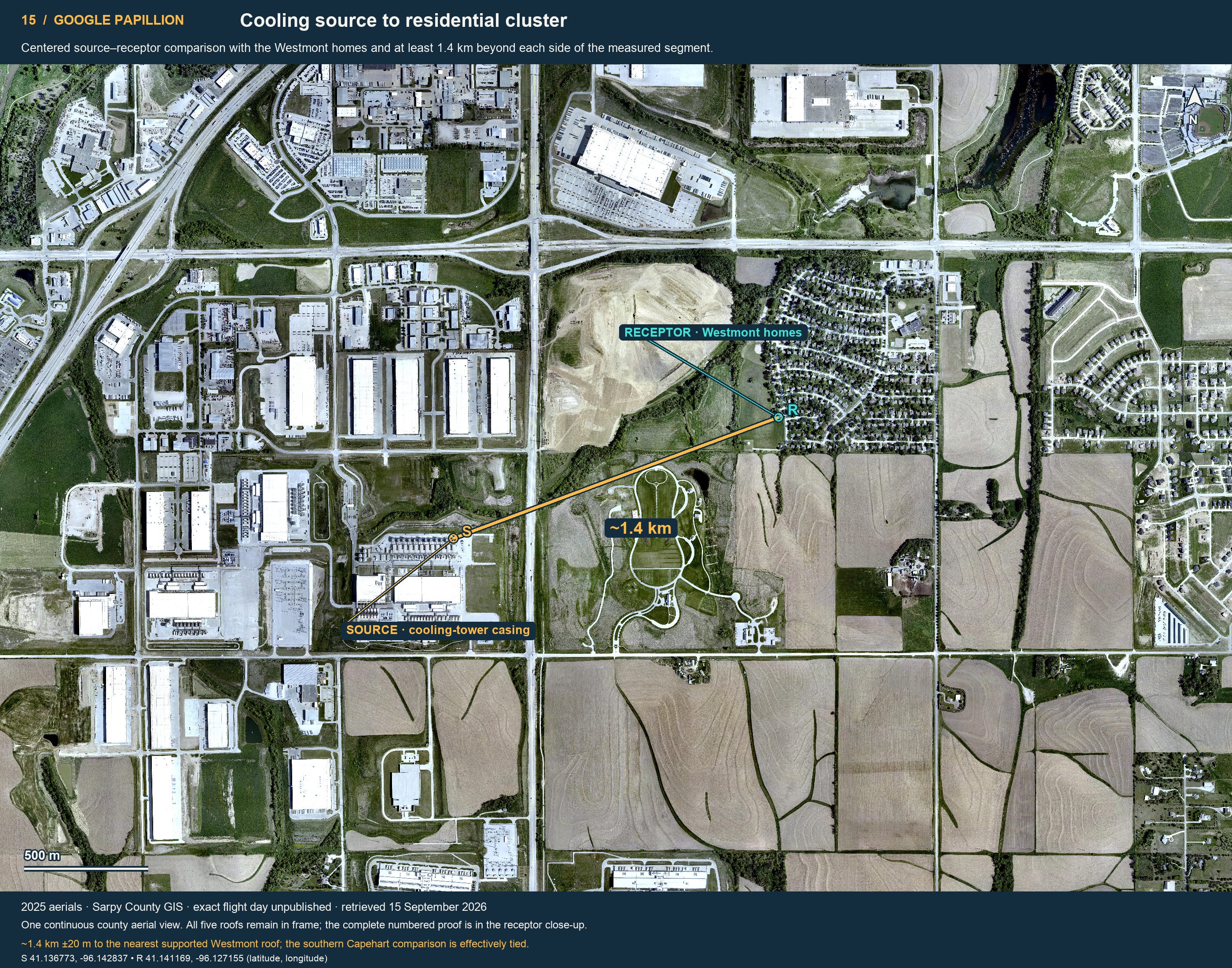
Google’s 237 MW Papillion campus in Nebraska has substantial open land between its cooling equipment and nearby neighborhoods. The nearest qualifying residential group is approximately 1.4 km away, producing a modeled cooling-noise estimate of 36.1 dBA. I found no verified operating-noise complaint attributable to this campus. A visiting county official also described it as quiet, although one visit cannot establish conditions throughout the year. It gets the lowest noise concern score.
#21 Microsoft Project Osmium IA, 190 MW
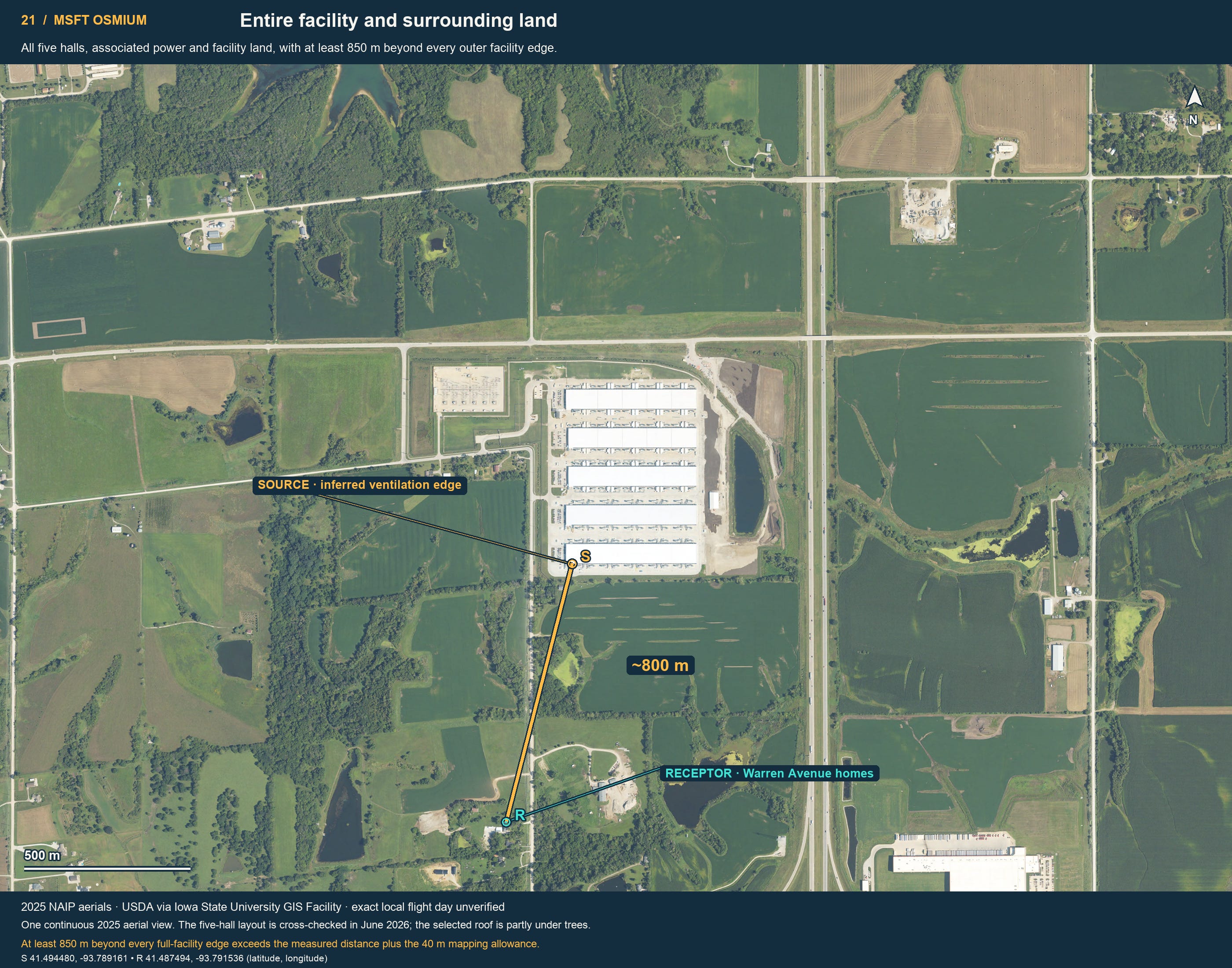
This 190 MW campus south of West Des Moines sits among fields, woodland and scattered farmhouses. There are approximately 800 meters between the selected ventilation source and the nearest qualifying residential group, resulting in a modeled estimate of 40.4 dBA. I found no verified ongoing cooling-noise dispute, giving it a noise concern score of 1. Residents have, however, complained about years of construction-truck noise, so its low score applies specifically to ordinary operation.
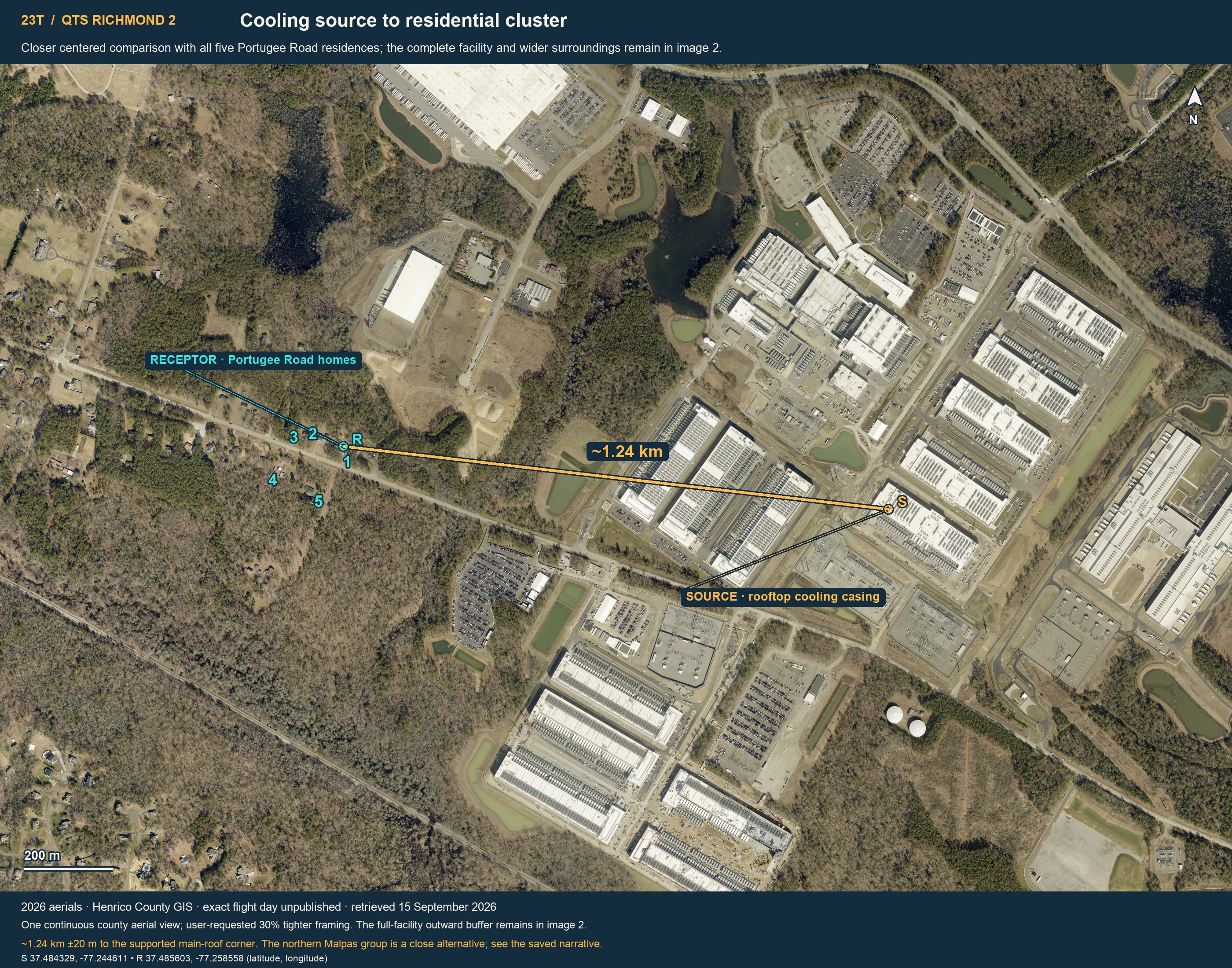
#23 QTS Richmond 2 VA, 180 MW
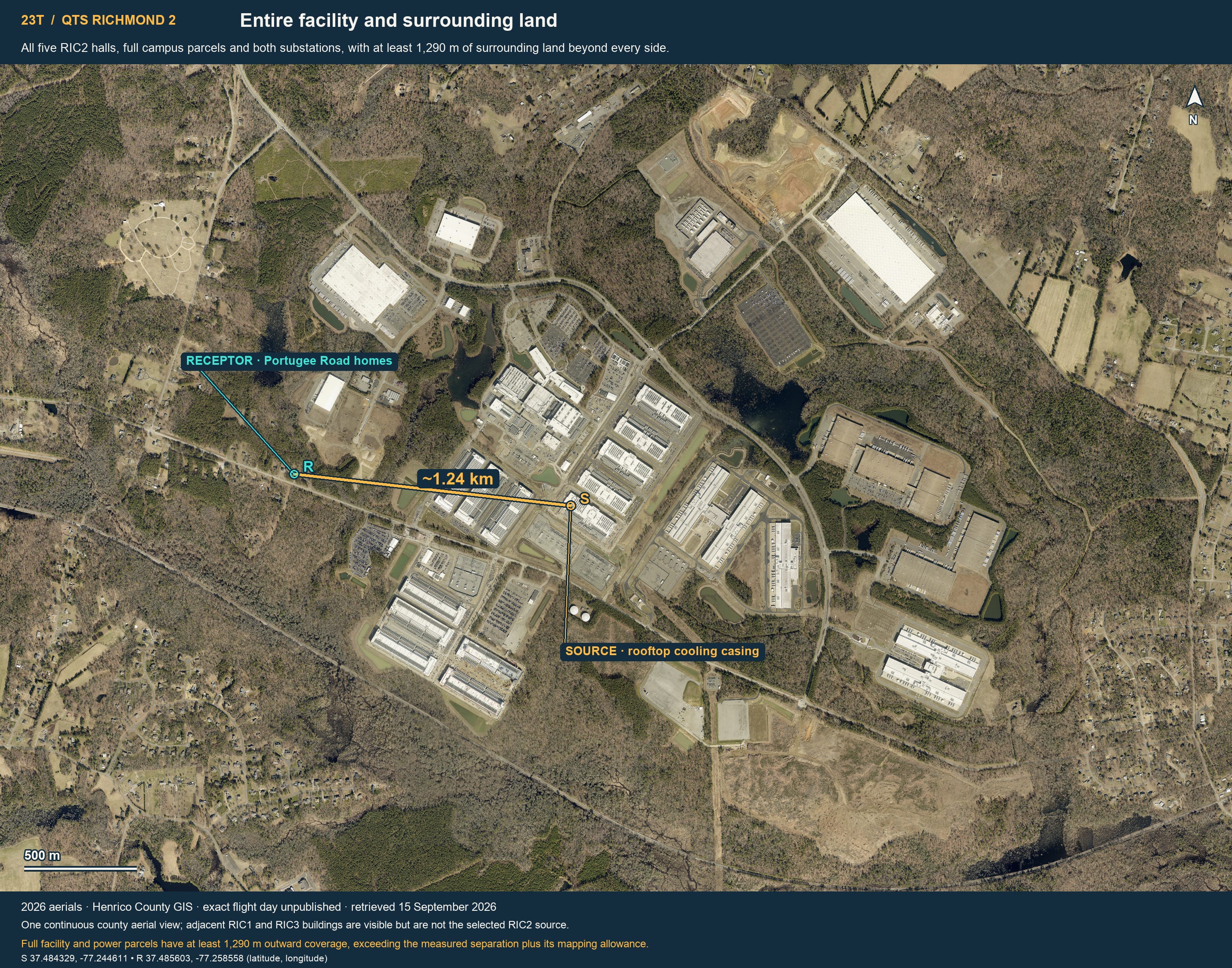
QTS Richmond 2 sits on a wooded industrial fringe outside Richmond, Virginia, with approximately 1.24 kilometers between its selected rooftop cooling equipment and the nearest qualifying residential cluster. At an estimated 180 MW of IT capacity, my model puts cooling noise at that home at 37.5 dBA. It receives 1/5 for reported noise concern because I found no verified current operating-noise complaint specific to this campus.
Conclusion
This project left me more sympathetic to the neighbors of hyperscale data centers than I expected. I went in assuming that most of these enormous facilities would be comfortably separated from residential neighborhoods. Many aren’t. And when residents describe a constant hum that follows them into their bedrooms or pollutes their backyards with an indistinct low frequency rumble, that deserves a serious response. Supporting the AI buildout doesn’t require dismissing the people who bear its most immediate costs.
But the findings also give me reasons for optimism. For 17 of the 25 campuses, I found no meaningful operating-noise complaints. That includes some enormous installations, and some surprisingly close to homes. New Carlisle is a particularly useful example: a 910 MW campus, roughly half a kilometer from the nearest residential cluster, without an established operating noise dispute that I could find. An absence of complaints isn’t proof of silence, but it does suggest that scale and proximity do not inevitably produce nuisance.
There is also evidence that intervention can help. At Mount Pleasant, Microsoft identified a tonal noise from its cooling fans and adjusted their operation; the firm reported that several neighbors later confirmed a resolution of the disturbance. That is an encouraging example of a specific engineering response producing reported improvements.
The practical lesson for data center operators is to make noise a design constraint from the beginning. Operators should focus on separation where possible, put the loudest equipment away from homes, specify appropriate acoustic controls, and test the result under realistic operating conditions. If a campus will routinely generate its own electricity – as I expect more will going forward – assess it as both a data center and a power plant. Then measure what reaches the neighbors and respond when the actual experience differs from the forecast.
This study offers a starting point for that process, not a universal safe-distance rule or a substitute for acoustic measurements. Interested parties should sponsor acoustic surveys to ground this debate in real data.
The objective of this study was to determine where scrutiny is most warranted and to provide examples worth learning from. We can build far more computing capacity while expecting operators to take responsibility for the noise they create. The AI buildout will be much easier to defend if its nearest neighbors can sleep through it.
There have been complaints, of course, about this site, but they didn’t pertain to operating noise. Residents complained about traffic noise and well failures; the state environmental authorities also identified air quality violations and wetland impacts, but none of these concerned noise
This part of the study was heavily AI assisted, with guidance and sanity checks from myself
dBA is an adjusted approach to decibels that takes into account the fact that humans are attuned to some frequencies more than others
I conducted a full satellite image analysis for all 25 sites, but I didn’t include it for all sites because it would have been tedious and made the article too long. If you are interested in any of the sites not covered in the case studies, send me a DM
Great research! Thanks for sharing.
Well researched and great use of analytics and a rating scale. The Microsoft intervention is hopeful that at least some of these issues can be remediated.
I reside in Loudoun County VA, the data center capital of the world. Our concerns include noise but also the industrialization of neighborhoods (large, ugly buildings, loss of trees and open space), and the additional power infrastructure (transmission lines/towers) needed for the centers, in some cases running through resident backyards. These are all consequences of close proximity to housing.
Perhaps extraterrestrial data centers are ultimately the way.